From one device to a multi-room plan
Owning Ayra in storage does not improve building hygiene by itself. You need a protocol: which rooms to treat, in which order, with which liquid, how long to leave for contact time and who moves the unit. This guide complements the Ayra Standard, Trolley and Mini product article: it focuses on facility organisation, not on repeating power or battery specs.
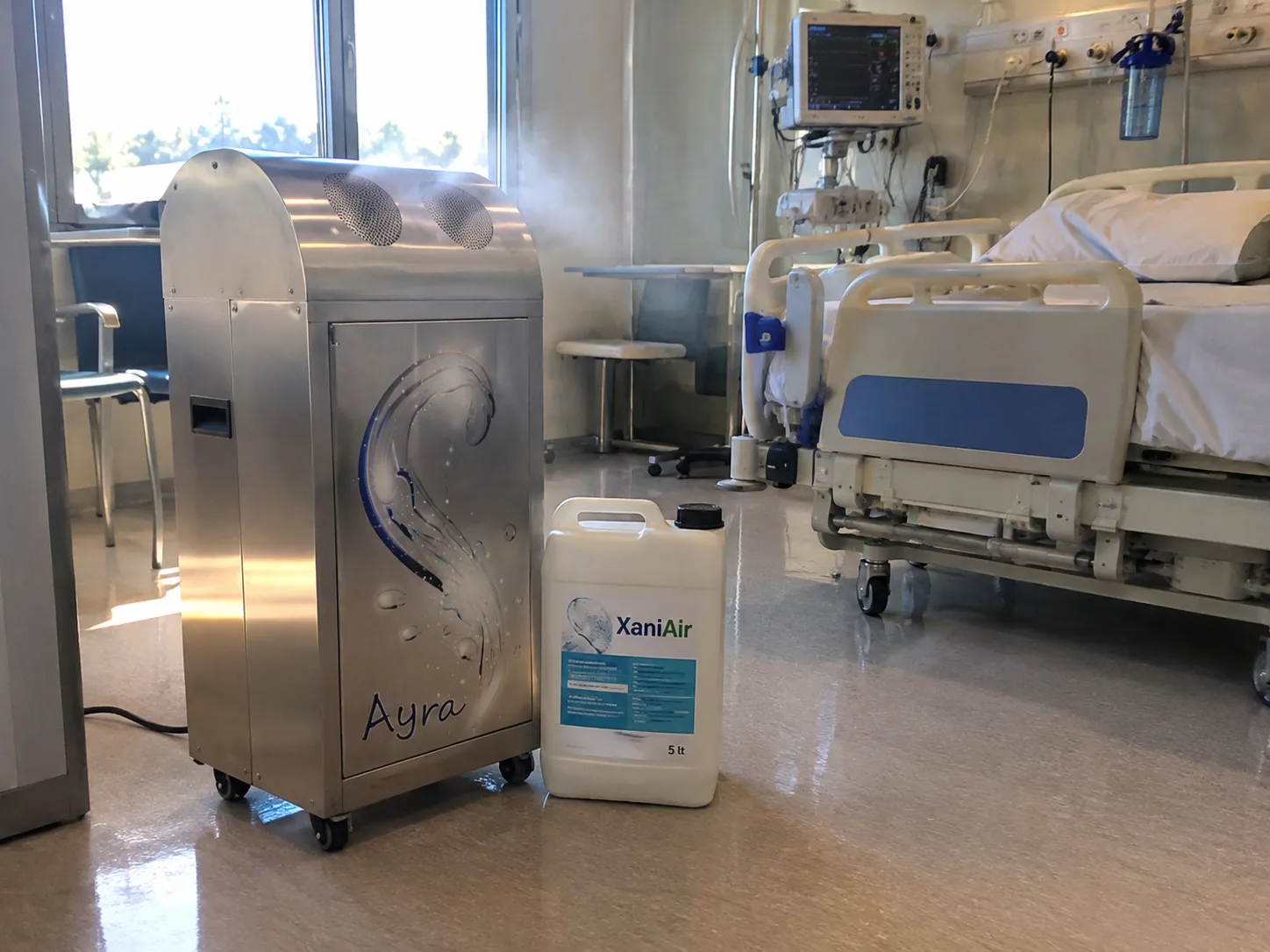
Ayra's operational strength is autonomy. Unlike many electrostatic systems that need an operator present for the whole pass, the device can stay in place with weekly, daily and hourly timers, and move on wheels (or the Trolley handle) between zones. Less labour per cycle means more coverage with the same cleaning headcount.
Size cycles on real cubic metres
Ayra's project reference mentions about 1,500 m³ treated in 5 hours and around 300 m³/h by repeating cycles. In practice you start from room volume (or net free volume if furniture is dense), decide whether one cycle is enough or repeats are needed, and check whether battery autonomy (indicatively about 5 hours) covers the available window without a nearby socket.
A common mistake is treating «by time» without a map: the same timer on a hotel suite and an open space yields different results. Prefer a simple table: room, m³, model (Standard/Trolley/Mini), cycle length, liquid, owner. The ~50 micron droplets and micro-nozzle pressure explain why air and gaps are reached; they do not replace deciding how long the area stays closed or controlled after fogging.
- Calculate m³ and obstacles (cabinets, curtains, tight layouts)
- Define a time window without guests or with limited access
- Choose fixed (Mini) or mobile (Standard/Trolley) units
- Align battery autonomy and charging point
- Log liquid used and batch for traceability
Hotels: room turnover and common areas
In hospitality, check-out sets the rhythm. Ayra Trolley or Standard can follow housekeeping flow: room vacated, unit placed, cycle programmed, room released after the liquid's required times. Common areas (lobby, meeting rooms, spa, in-house gyms) are better treated at fixed night or low-traffic hours with a weekly timer instead of ad-hoc passes.
What guests and staff perceive is not only «we own a machine», but a visible, repeatable protocol. Assigning operational ownership (who moves, who charges, who signs the room sheet) stops the device sitting idle between peaks. Where a surface plan with SDC or other sanitizers already exists, fogging completes hard-to-wipe points without replacing basic mechanical cleaning.
Offices and schools: density and breaks
In offices and schools, peaks are arrival, break and departure. It makes sense to schedule cycles on meeting rooms, classrooms, open spaces and restrooms after hours or between shifts, using Mini where space is small and fixed, Trolley where you rotate across floors. Optional connectivity (wireless, Bluetooth, SIM) helps if facility manages several units and wants remote confirmation of start, but it is not required to begin.
Training beats a brochure: whoever runs Ayra must know which liquids are allowed, how to fill the tank, how to set the timer and what to do if the area cannot stay empty. A short laminated protocol near the machine store reduces errors more than a long unread manual.
Clinics and healthcare: only where protocol allows
In outpatient clinics, care homes and medical centres, Ayra can enter zones allowed by the hygiene lead, typically rooms not reserved for sterile procedures. It does not replace sterilisation or specific clinical protocols. Value sits in repeatability on waiting rooms, corridors, consulting rooms and restrooms, with stainless units and AISI 316/Teflon liquid-contact parts suited to repeated professional use.
Before rollout you need approval on the liquid, re-entry times and integration with written procedures. A controlled trial on two sample rooms beats immediate extension to a whole floor. Project Vending can support Standard/Trolley/Mini selection alongside the liquid discussion (including SDC where appropriate) without overriding the site's internal rules.
| Context | Typical model | Useful window |
|---|---|---|
| Hotel room after check-out | Trolley / Standard | Between guest exit and next arrival |
| Lobby / common rooms | Standard / Trolley | Night or low traffic |
| Open space / classrooms | Trolley | After hours or between shifts |
| Reception / small studios | Mini | Fixed on furniture, short cycles |
| Clinic waiting rooms | Standard / Trolley | End of day or closed slots |
Checklist to launch the protocol
Before requesting a quote, prepare: room list with m³, available hours, whether people are present during the cycle, any already approved liquid, number of floors/zones and whether you need Trolley handles or fixed Minis. Adding weekly timer needs and central battery charging avoids field surprises.
Via the contact form with project type «Sanitization», Project Vending helps turn this map into a fleet and cycle plan, optionally pairing Xaniair/SDC surface solutions. The goal is a rhythm staff can sustain, not a one-off demo.
- Room map and cubic metres
- Treatment hours and access rules
- Model mix and unit count
- Liquid, contact times and re-entry
- Owners for moving, charging and logging cycles
FAQ
Does this guide replace the Ayra product sheet?
No. This covers multi-room protocol. Power, batteries and Standard/Trolley/Mini differences are in the Ayra product article.
Is an operator needed during the whole fogging cycle?
Ayra is designed for autonomous timed cycles. Someone still places, programs, charges and controls area safety.
How many rooms can one unit cover?
It depends on m³, cycle length and move logistics. Size it from the room map, not a universal fixed number.
Can it run with people present?
It depends on the liquid and site rules. Many cycles run in controlled or empty areas: define this in the protocol.
How does it integrate with surface sanitization?
Fogging covers air and hard-to-reach points; surfaces stay in the cleaning plan. SDC and manual steps are not automatically replaced.
Ready to get started?
Request a free consultation: we'll call you back within one business day with datasheets, a quote and location advice.