From product sheet to hygiene plan
Knowing silver dihydrogen citrate (SDC) is not enough to improve building hygiene. You need an operating plan: which touchpoints to treat, how often, who performs the step and how results are checked. The Xaniair solution fits this frame as a surface product to integrate into hotel, office, healthcare, food service, school and public-transport procedures.
This guide complements the technical Xaniair/SDC article. It does not repeat the chemical profile: it focuses on context, ownership and work sequence. Real use remains bound to the label, datasheet and local rules, especially on food-contact surfaces or clinical areas.
Map high-traffic touchpoints
Start by listing surfaces many people touch every day: handles, button panels, reception desks, break tables, waiting-room seats, switches, trolleys, restrooms, handrails and vending surfaces. Not all need the same rhythm: a high-turnover hotel bathroom is not a meeting room used twice a week.
A simple map (zone, surface, material, frequency, owner) avoids random treatments and waste. On paints, glazed tiles, plastic, metal, glass and glazed porcelain stoneware the solution is indicated as applicable; on unvalidated materials, spot-test a small area before rollout.
- Reception, lobby and corridors
- Restrooms and changing rooms
- Meeting rooms, classrooms and open spaces
- Kitchens, counters and food areas if authorised
- Vehicles and transport / shuttle spaces
Hotels and hospitality
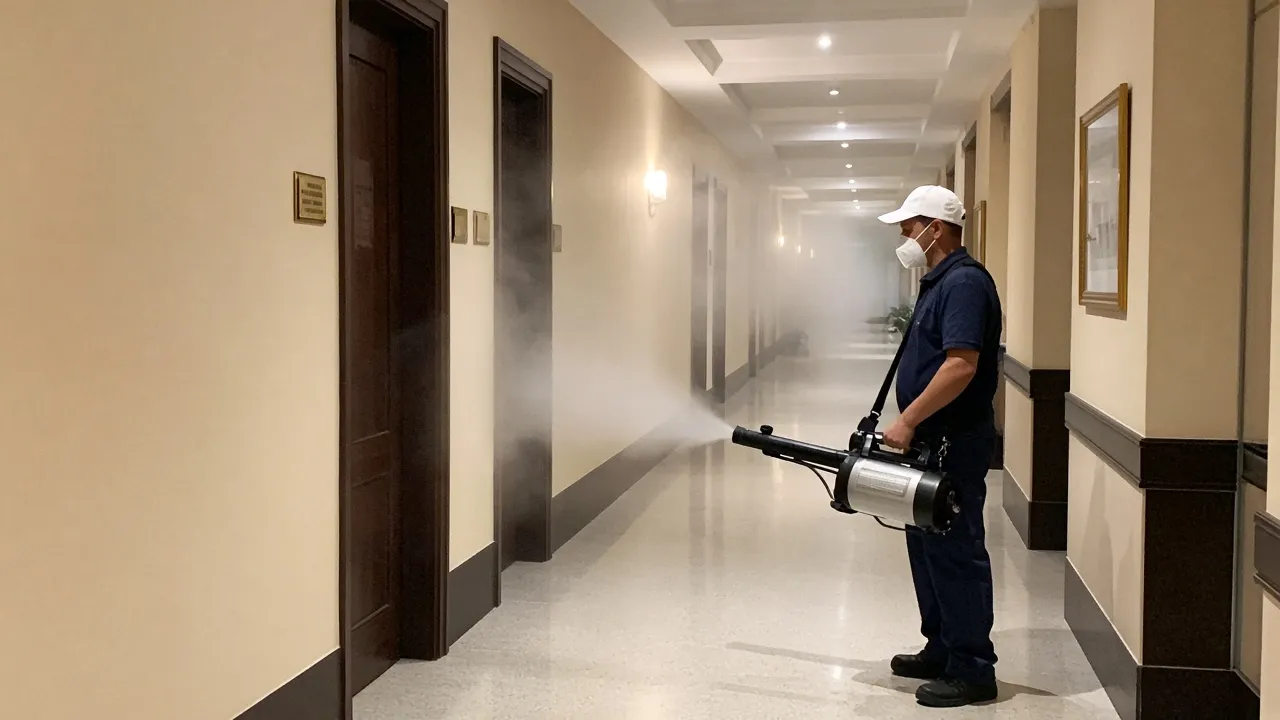
In hotels, surface sanitization follows check-out rhythm and reputation. Housekeeping needs clear products, workable contact times and non-intrusive odours. A colourless, odourless aqueous base helps guest experience, provided staff are trained on any dilutions, timings and storage.
Typical critical points are room handles, remotes, switches, bathrooms, lifts and common areas. Where an air sanitizer (Ayra/Xaniair) already runs, the best logic is complementary: continuous air treatment, surfaces on defined intervals. Do not replace a protocol with a residual claim: declared residuality up to 24 hours must be read per datasheet and use conditions, not as an exemption from regular cleaning.
Offices, schools and shared spaces
In offices and schools the issue is density and sharing: keyboards, shared mice, handles, microwaves, vending machines and restrooms. A realistic plan distinguishes daily opening, peaks (arrival/departure, lunch) and extraordinary interventions after events or illness-related absences.
Staff training for cleaning or facility teams matters more than technology alone. If the product is ready to use, dosing errors drop; contact times and surface compatibility remain mandatory. For facility managers, measuring compliance (signed checklists, respected frequency) beats buying volume without a process.
Healthcare and food: local protocol first
In hospitals, clinics and care homes, Xaniair can enter only where the internal protocol allows it, typically on areas and surfaces not reserved for specific clinical procedures. It is not a substitute for sterilisation or for products reserved to high-risk contexts without validation by the hygiene lead.
In restaurants and food service, any use on food-contact surfaces depends on registration, label and country rules (including any no-rinse profile declared in some dossiers). Before adding it to HACCP you need updated documentation, approved contact times and training. A limited, verified adoption beats a wide rollout without traceability.
| Sector | Operational focus | Mistake to avoid |
|---|---|---|
| Hotel | Rooms, bathrooms, common touchpoints | Skipping contact times for speed |
| Offices / schools | Shared and break areas | Treating everything at the same rhythm |
| Healthcare | Areas allowed by protocol | Using outside clinical instructions |
| Food | Surfaces authorised on the label | Adding to HACCP without documents |
| Transport | High-touch handles and seats | Interventions without an operating window |
Integrate surfaces and air sanitization
Project Vending offers both the Xaniair solution and Ayra/Xaniair air sanitizers. Correct integration separates two levels: air is managed continuously; surfaces are treated on cycle. In one brief, define rooms, airflow/areas for sanitizers and a touchpoint map for chemistry.
To start, use the contact form with project type «Sanitization»: environments, materials, current frequencies and food/healthcare constraints. From there you can assess an on-site trial, volumes and alignment with product documentation. The goal is a plan staff can execute, not a brochure.
- List of rooms and ownership
- Touchpoint and material map
- Current vs target frequencies
- Food / healthcare / people-present constraints
- Optional pairing with air sanitizers
FAQ
Does this guide replace the technical Xaniair article?
No. This one covers operating plans by sector. Chemistry, cited safety and compatible surfaces are in the SDC/Xaniair article.
Can it be used in every hospital area?
No. Only where the internal protocol and label allow it. The hygiene lead defines the perimeter.
Is cleaning still needed if residuality is 24 hours?
Yes. Declared residuality does not replace cleaning and frequencies set in the hygiene plan.
How does it pair with Ayra sanitizers?
Continuous air treatment, surfaces on intervals. Design them together, but keep two intervention levels.
What should I prepare for a quote?
Room/touchpoint map, materials, frequencies, food or healthcare constraints and whether air units are also needed.
Ready to get started?
Request a free consultation: we'll call you back within one business day with datasheets, a quote and location advice.