
What a smart city really means
A smart city is an urban model that manages resources more consciously. The goal is not technology for its own sake, but economic and energy sustainability that improves residents' quality of life. In a smart city, traditional networks and services become more efficient through digital solutions that help citizens and businesses.
The idea goes beyond gadgets. It is a different way of reading urban space, centred on wellbeing and energy efficiency. Research suggests that well organised contexts can support health, lower pollution, more jobs and measurable economic returns for the territory. The practical test remains simple: infrastructure, data and services must answer everyday needs, not slogans.
For municipalities, utilities, sharing operators and urban-infrastructure manufacturers, the useful question is not «how smart is this city», but which services can become simpler, safer and easier to maintain. Only from that reading does it make sense to choose sensors, charging stations, lockers, software and governance models.
Connectivity, sensors and useful urban data
Smart cities usually have a high level of connectivity. Distributed sensors and systems collect large volumes of data on traffic, air quality, accessible parking locations, service usage and infrastructure status. That information can feed more advanced real-time services and help administrations manage resources more precisely.
Data creates value only when it improves a decision. Knowing whether a mobility node is saturated, whether a charging station is offline or whether demand peaks at certain hours changes planning and maintenance. Every digital project should therefore start from an operational question: which decision improves if we have this information? Without that clarity, a city can become more instrumented without becoming smarter.
Data protection and clear responsibilities also matter. A reliable urban service explains what is collected, why, who manages it and for how long. That approach makes it easier to involve residents, private operators and technical offices in the same project.
Sustainable mobility and electric micro-mobility
A smart city also supports more sustainable mobility: e-bikes, electric scooters, interchange with public transport and spaces designed for short low-impact trips. Micro-mobility works only when the territory offers parking, charging, battery swap and clear rules of use. Without physical infrastructure, the digital offer stays incomplete.
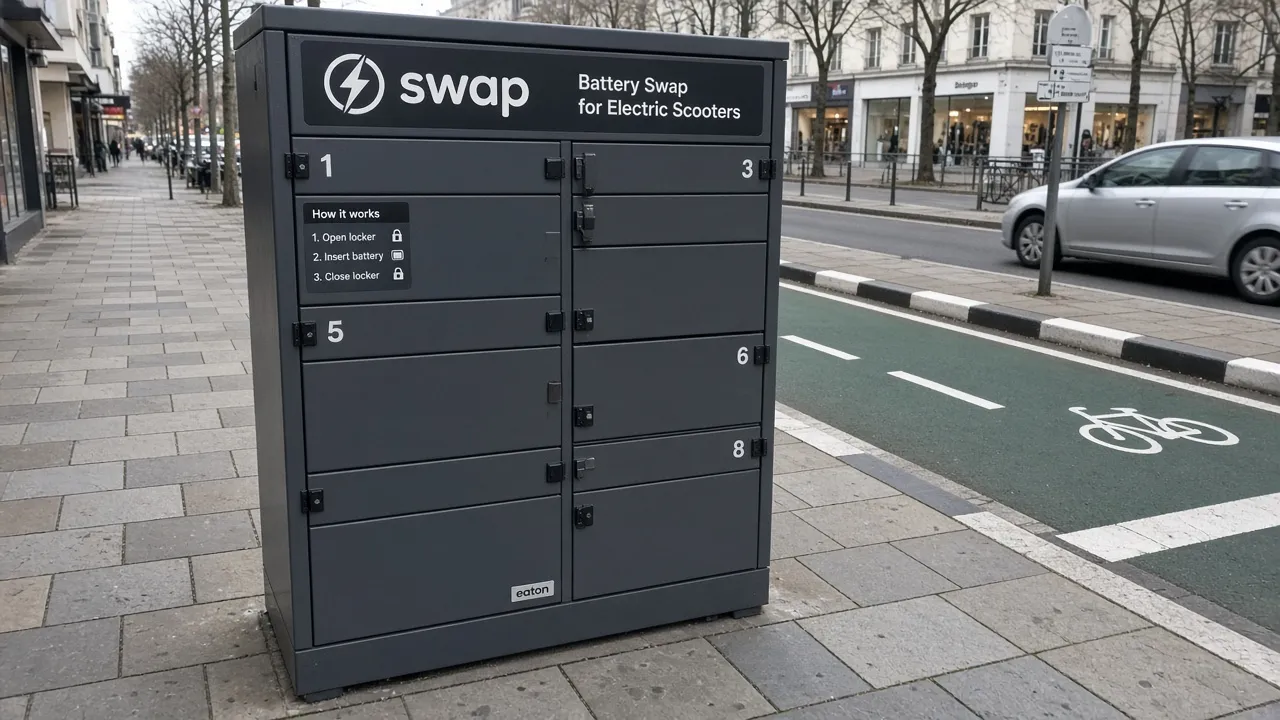
Electric scooters raise a typical shared-fleet issue: range, charging time, battery health and station distribution. A smart-mobility project must therefore connect vehicle, battery, station and operating model. This is where Project Vending has applied mechanics, electronics and firmware skills from professional vending to urban charging and battery-swap solutions.
Treating the station as a professional automatic system has a concrete advantage: a readable interface, clear LED statuses, controlled access, correctly sized power supply and spare parts designed for continuous operation. It is the same method used for lockers and vending machines in high-traffic environments.
The six dimensions of a smart city
A common framework distinguishes six dimensions. They are not decorative labels: they help municipalities, designers and companies decide where to act and with which priority.
- Smart People: residents need access to useful data and tools to interpret it, becoming active participants in decisions
- Smart Governance: administration focuses on knowledge, environmental resources, human relationships and community assets
- Smart Economy: urban commerce uses technology as a means, not an end
- Smart Living: health, education, safety and culture remain accessible to everyone
- Smart Mobility: intelligent mobility solutions with contained costs and lower environmental impact
- Smart Environment: sustainable development, low environmental impact and energy efficiency
These dimensions overlap. A battery charging station is not only a Smart Mobility device: it also touches environment, service economics, daily experience and territorial governance. When a project answers several dimensions at once, technical offices, departments and private partners understand it more easily.
From linear economy to circular economy
For sustainable development, a smart city should move from the linear «produce, use, discard» model toward a circular economy. That means reuse, sharing, repair, refurbishment and recycling of existing materials and products, with the aim of cutting waste and harmful emissions for people and the environment.
In micro-mobility this principle is concrete. A battery designed to be swapped, monitored and repaired lasts longer and reduces the need to replace whole vehicles. A station built with modular shelves, available spare parts and updatable software avoids discarding entire infrastructures when a charging protocol changes. Circularity here means designing maintenance and life cycle from day one.
A real project: scooter batteries and charging stations
One of the end-to-end projects developed by Project Vending for smart-city innovation, in collaboration with a European university, covered the design of an electric-scooter battery and the charging stations to be rolled out across cities. The work went beyond a graphic concept: it combined applied electrochemistry, compartment mechanics, user interface, payments and power management.
The scooter battery charging station is the physical point where the service becomes usable. Users can see whether a battery is ready, charging or depleted; operators can see availability, cycles and intervention needs. It follows the same logic as professional vending: an automatic, readable and maintainable infrastructure designed to work without continuous on-site staff.
BMS for lithium-ion and supercapacitor batteries
Following this project opportunity, Project Vending expanded its battery know-how to client requirements, working on BMS (Battery Management System) solutions for lithium-ion batteries and for supercapacitor batteries. The two families serve different profiles: energy density, charge speed, life cycles, thermal safety and discharge behaviour.
The BMS is not an accessory: it protects cells and users, balances charge, communicates with the station and enables reliable services. In an urban setting, with variable conditions and intensive use, BMS quality and thermal design matter as much as machine aesthetics. Every configuration must therefore be validated against the real battery specification and the fleet operating model.
Technical characteristics of the charging station
The reference station developed in the project is an industrial system, not a simple electrified shelf. The typical layout has two compartments: a technical bay and a battery bay. The standard configuration includes 9 shelves, each with 3 charging positions, plus 3 free shelves for expansion or product variants.
| Element | Reference specification |
|---|---|
| Architecture | 2 bays: technical and batteries |
| Positions | 9 shelves × 3 positions + 3 free shelves |
| Status signalling | LED charged / charging / depleted |
| Monitor | 21.5" |
| Computer | Compact Windows PC |
| PC continuity | Dedicated UPS |
| Power supply unit | 24 V · 20.8 A · 500 W |
| Mains / energy | Single-phase, three-phase or solar panels |
| Payments / access | Card reader |
| Machine climate | Dedicated ventilation |
These figures describe a project configuration and must be checked case by case. Grid or photovoltaic supply, number of positions, access protocol and shelf layout can change after a site survey, demand estimate and battery specification. Project Vending can develop charging stations and logic around the client's technical requirements.
How to place this infrastructure in an urban project
For a municipality, sharing operator or urban-furniture partner, the station should be presented as a service node, not an isolated object. Teams need to know where batteries end up, who swaps them, how the service is funded and who maintains shelves, electronics and software. A credible proposal links layout, electrical or photovoltaic power, accessibility, safety and usage indicators.
The link with other Project Vending solutions is natural: e-bike stations, solar canopies, lockers and service totems can share telemetry, payments and maintenance logic. The commercial goal is not to sell a single piece of hardware, but to help the client build a concrete piece of smart mobility inside a wider intelligent-city strategy.
- Define users, fleet and swap or charging model
- Check site power, space, accessibility and safety
- Align BMS, positions and software with real batteries
- Plan maintenance, spare parts and updates
- Integrate the node with mobility, urban furniture and communication
FAQ
What is a smart city in practical terms?
A city that uses data, infrastructure and digital services to manage resources, mobility and quality of life better, without reducing everything to technology for its own sake.
What has Project Vending developed in this field?
In collaboration with a European university it worked on scooter batteries and related charging stations, including BMS for lithium-ion and supercapacitor packs.
Can the station be powered by solar panels?
Yes. The project configuration supports single-phase, three-phase or photovoltaic supply. The solution must be sized for the site.
How many batteries can one station handle?
The indicated standard layout has 9 shelves with 3 positions each, plus 3 free shelves. Count and layout can be adapted.
Can stations be built to client specifications?
Yes. Project Vending develops innovative projects based on the battery's technical characteristics and the client's operating needs.
Ready to get started?
Request a free consultation: we'll call you back within one business day with datasheets, a quote and location advice.