
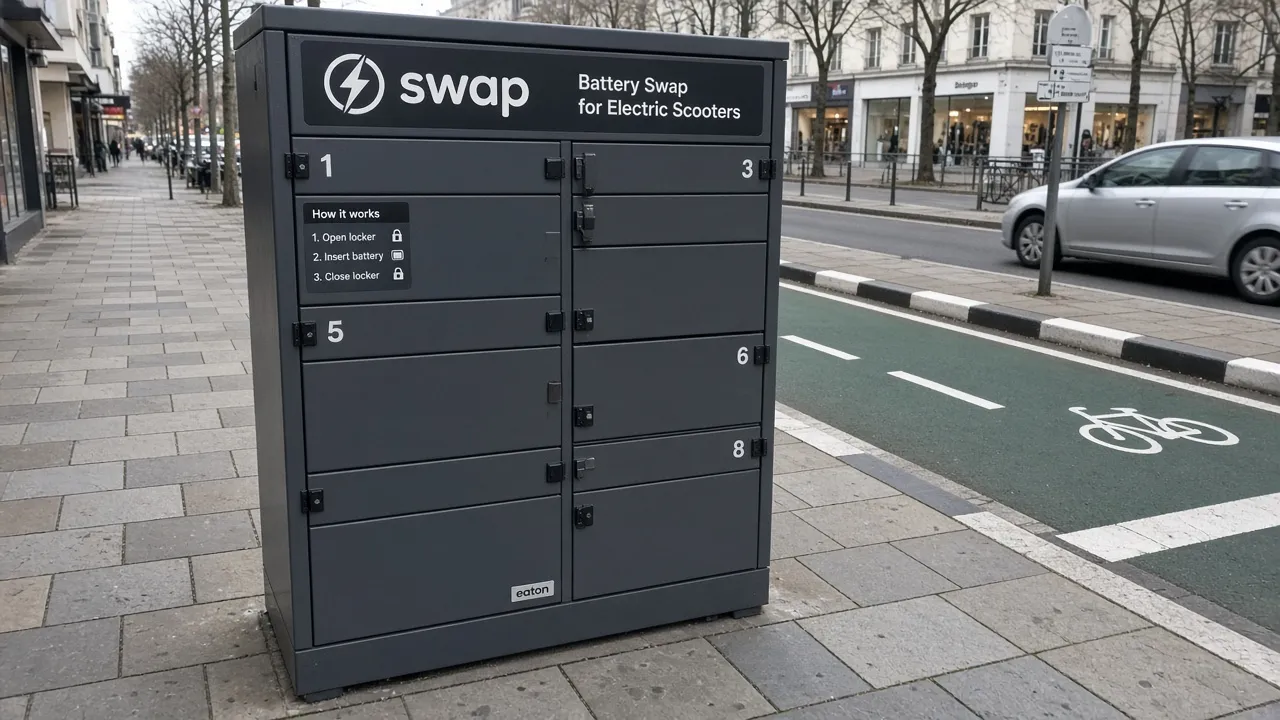
Why scooter fleets need a battery station
In shared fleets the bottleneck is rarely the scooter frame: it is the battery. Remaining range, charging time, life cycles, safety and collection logistics decide whether the service stays available in the city or stops. A battery charging and swap station turns that problem into an automatic process: the user or operator returns a depleted pack, takes a charged one and the system logs status, cycles and availability.
Project Vending developed end-to-end, in collaboration with a European university, both the design of a scooter battery and the charging stations to be rolled out across cities. The approach matches professional vending: mechanics, electronics, firmware, interface and maintainability in one project, built to run without continuous on-site staff.
This guide is technical and commercial. It does not repeat smart-city theory: it covers BMS, dual-bay layout, LED signalling, power supply and the brief needed before a custom build. It is for sharing operators, municipalities, system integrators and OEMs that must check whether a battery station truly matches their pack specifications.
Station swap versus on-vehicle charging
Charging the battery on the scooter takes time and leaves the vehicle idle. Station swap cuts downtime: the empty pack stays on the shelves while the vehicle returns to service. The model works only if the station is readable, safe and sized for the real number of packs in circulation.
During design, clarify who performs the swap (end user, charging rider, operator staff), with which authentication and which priority rule for ready batteries. Those answers drive the card reader, monitor UX, number of positions and software logic. A generic station that ignores the operating flow creates queues or unused shelves.
Lithium and supercapacitor: two families, two BMS designs
After the university project, Project Vending expanded battery know-how to client needs, working on BMS for lithium-ion batteries and BMS for supercapacitor batteries. They are not interchangeable: energy density, charge speed, discharge profile, thermal management and cycle life differ substantially.
The BMS protects cells and users, balances charge, talks to the station and exposes reliable states (ready, charging, depleted or out of range). In intensive urban use, BMS quality and thermal design matter as much as machine aesthetics. Every shelf position must therefore be validated on the real pack: connector, current, voltages, protocols and safety thresholds.
- BMS for lithium-ion batteries: energy density and range typical of fleets
- BMS for supercapacitor batteries: faster charge/discharge profiles, to validate on the duty cycle
- Mandatory alignment between pack, shelf, PSU and station firmware
- LED signalling consistent with the real BMS status
Station layout: two bays and modular shelves
The reference station has two bays: technical and batteries. The technical bay hosts power supply, PC, UPS and control components; the battery bay hosts the charging shelves. The standard composition includes 9 shelves with 3 positions each, plus 3 free shelves for expansion, pack variants or buffer zones.
LEDs tell users whether batteries are charged, charging or depleted. A 21.5" monitor and a compact Windows PC guide interaction; a UPS protects the PC from micro-outages. The reference PSU is 24 V, 20.8 A, 500 W. Supply can be single-phase, three-phase or solar, sized through a site survey. Access/payment uses a card reader; dedicated ventilation manages machine climate.
| Element | Reference specification |
|---|---|
| Architecture | 2 bays: technical and batteries |
| Positions | 9 shelves × 3 positions + 3 free shelves |
| Signalling | LED charged / charging / depleted |
| Monitor | 21.5" |
| Computer | Compact Windows PC |
| Continuity | UPS for PC |
| PSU | 24 V · 20.8 A · 500 W |
| Energy | Single-phase, three-phase or photovoltaic |
| Access | Card reader |
| Climate | Dedicated fan |
These figures describe a project configuration. Shelf count, power, access protocol and layout can change with demand, available space and battery specs. Before locking a tender specification, confirm the buildable configuration with Project Vending.
What a useful technical brief must include
A useful brief does not start from a rendering. It needs the battery datasheet (chemistry, voltages, charge current, connector, size, weight, BMS protocol), the operating model (user swap or staff logistics), target packs per site, electrical or photovoltaic constraints and access rules. It also needs outdoor/indoor notes, anti-vandal requirements, maintenance and spare parts.
Commercially, clarify who buys and who operates: municipality, sharing operator, utility or urban-furniture partner. The station can join a smart-mobility node network with e-bike charging, solar canopies and lockers. The value is integrating mechanics, electronics and software to client specs, not selling a generic electrified cabinet.
- Pack datasheet and BMS requirements
- Swap flow and user profile
- Site power and solar option
- Footprint, accessibility and safety
- Maintenance model and spare parts
Custom builds on the client's battery specs
Project Vending can deliver innovative projects based on the technical characteristics of the client's battery. That includes shelf adaptation, charging logic, signalling, authentication and interface. A typical path covers pack analysis, layout definition, position prototyping, safety validation and documentation for installation and operation.
For buyers comparing suppliers, the discriminating criteria are few: real pack alignment, clear LED states, maintainable shelves, PC continuity, energy flexibility and after-sales support. A well designed station reduces vehicles out of service and makes battery availability measurable, which is the metric that matters for an urban fleet.
FAQ
How is this guide different from the smart-city article?
The smart-city article covers the urban context. This guide focuses on the station, BMS, layout and technical brief for a scooter battery project.
Did Project Vending develop only the station?
No. The European university project covered the scooter battery and the charging stations, with BMS for lithium-ion and supercapacitor packs.
How many positions does the standard configuration have?
9 shelves with 3 positions each, plus 3 free shelves. Layout and capacity can be adapted.
Can the station run on photovoltaic power?
Yes, in addition to single-phase and three-phase. Sizing depends on load, exposure and required autonomy.
Can you customise for my battery pack?
Yes. The company builds the station and charging logic around the client's battery specifications.
Ready to get started?
Request a free consultation: we'll call you back within one business day with datasheets, a quote and location advice.