
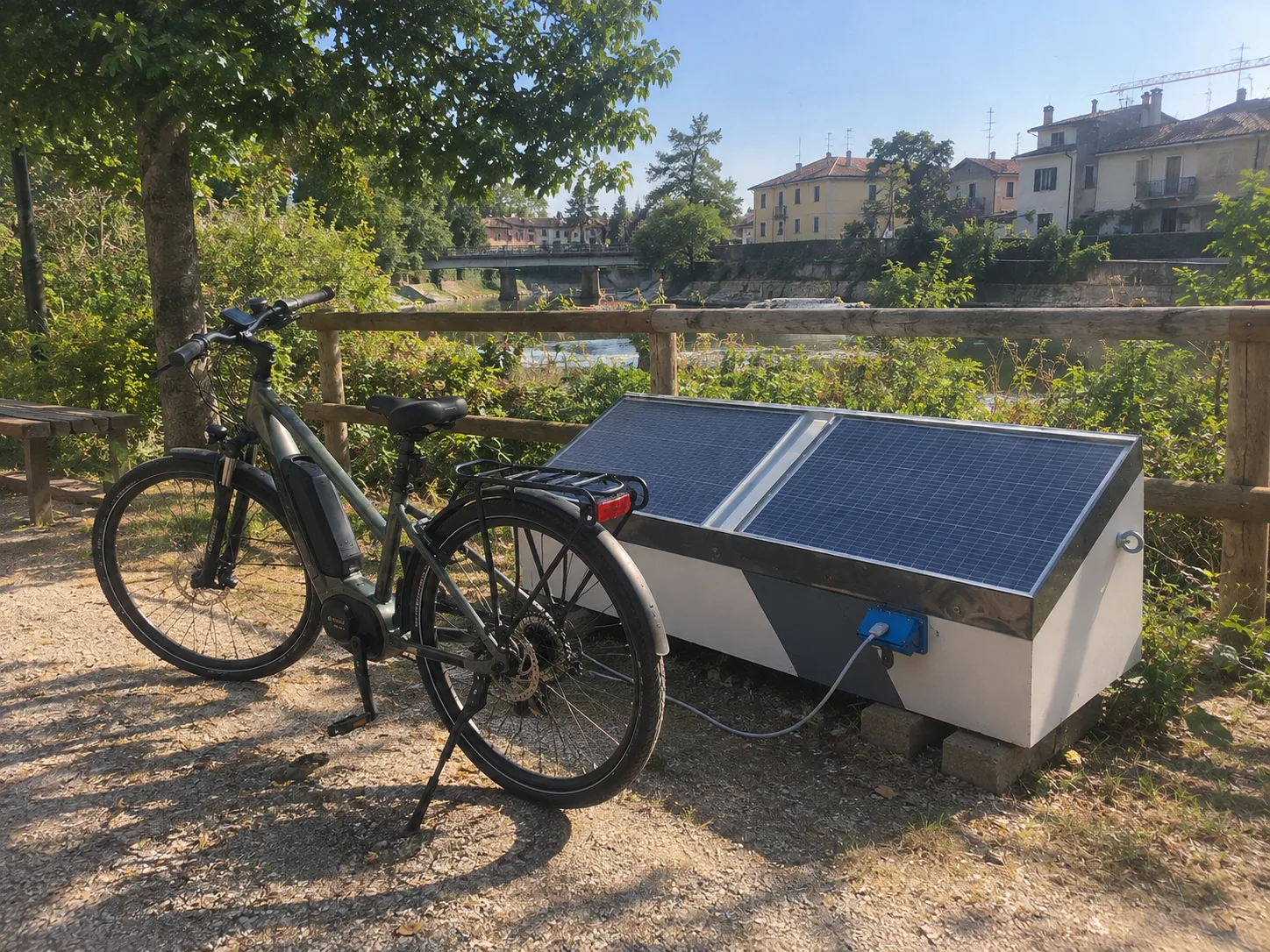
Urban furniture is becoming public-service infrastructure
Urban furniture has traditionally meant benches, bins, bollards, shelters and wayfinding systems. These elements still shape the quality of a public space, but current projects are expected to do more: support new habits, offer useful services and make the city easier to use. As electric bicycles become more common, cycling routes, parks, tourist areas and mobility hubs need places where riders can stop and recharge. That need creates room for a new type of urban product.
For urban furniture manufacturers and distributors, a solar e-bike charging station is not simply another technical item to add to a price list. It is an infrastructure component that can be included in a broader sustainable mobility proposal, alongside paving, lighting, signage and seating. The commercial value lies in helping a client create a coherent, equipped place rather than selling a standalone solar panel.
What a solar e-bike charging station is
A solar e-bike charging station combines bicycle parking with a system designed to provide charging power. It is intended for outdoor use and can be considered for public, private or semi-public locations. The actual configuration depends on the model, the number of charging points, the site and the expected use. A technical datasheet and a site review are therefore essential parts of a responsible proposal.
Solar power should be described accurately rather than as a generic promise of free energy or guaranteed savings. Solar exposure, orientation, shade, seasonality and user demand all affect the performance of an installation. A professional proposal explains what the solution can contribute and identifies which aspects must be checked during design. This gives municipalities and designers information they can use when assessing installation, operation and maintenance.
Why add it to an urban furniture catalogue
Adding an e-bike charging station allows a manufacturer to expand into sustainable mobility while staying close to its existing market. The relevant decision-makers are already familiar: municipal technical departments, architects, cycling-infrastructure designers, park managers, hospitality operators and companies delivering public works. A supplier can bring the solution into the concept stage, when the project team is deciding which functions, materials and services belong in the space.
The station can also strengthen existing proposals. A shelter can become an equipped stopping point; a cycleway can include a useful service node; a plaza can gain a visible feature connected to electric mobility. The product is not being sold as a solar panel. It is being presented as an urban element with a clear purpose. That shift makes the conversation more relevant to the client and more valuable to the reseller.
- Expand the catalogue with a sustainable mobility solution
- Open conversations with municipalities, designers and site operators
- Participate in integrated urban furniture and infrastructure projects
- Create project-specific proposals and configurations
Where to propose e-bike charging in public spaces
Cycleways are the most obvious setting, but they are only one possibility. A station can be considered at a rest point along a cycling route, near a public park, at the entrance to a tourist area or close to a railway station. The location should be visible, accessible and aligned with how people move through the site. Other services, such as maps, lighting, drinking fountains or seating, can help make charging part of a natural stop rather than an isolated device.
There are also semi-public and private settings with a strong collective function: campuses, hotels, campsites, offices, industrial districts and park-and-ride facilities. Each one has a different brief. The client may want to improve the visitor experience, support employees or strengthen the identity of a site. An urban furniture manufacturer can offer the same product family with finishes, layouts and management options adapted to each project.
| Setting | Project need | Typical decision-makers |
|---|---|---|
| Cycleways and long-distance routes | A service point along the journey | Municipalities, territorial bodies, operators |
| Parks and tourist areas | Connect mobility with public-space use | Cities, parks, tourism operators |
| Campuses and companies | A service for staff, visitors and users | Facility and property managers |
| Mobility hubs and park-and-ride | Link cycling with other transport modes | Transport operators and authorities |
Turning an ordinary public area into an equipped place
The station works best when it is designed with the site, not added after the rest of the project is complete. The first question is what type of behaviour the project wants to support: a short stop on a cycleway, a longer visit to a park, commuting by bike or a connection with public transport. That decision influences location, visibility, capacity, shelter, circulation and the relationship with the rest of the furniture.
The design review should cover accessibility, safety, drainage, lighting, solar exposure, impact protection and maintenance access. In a public space, instructions must be easy to understand and connectors must be reachable without creating obstacles. A professional proposal therefore includes more than a product image. It should provide dimensions, installation guidance, operating information and the documentation needed by the designer and technical office.
A commercial opportunity for manufacturers and resellers
The station can be sold in several ways. It can become a dedicated catalogue line, part of a cycling-infrastructure package or one element of a turnkey public-space project. A reseller may present it alongside shelters, benches, bike racks, lighting and wayfinding. A manufacturer may focus on finishes, branding and structural integration so the station fits its existing urban furniture system.
This flexibility makes it possible to speak to different stakeholders without changing the core positioning. To a city, the product is a public-space service. To a designer, it is a component of a wider concept. To an operator, it is an equipped point within a managed site. To a distributor, it is a new reference for the sales network. The product remains the same, but the proposal uses the language and detail each project requires.
How to include it in tenders and urban projects
When a charging station is included in a tender or technical proposal, its function should come before its appearance. The document should explain the need being addressed, the intended users, the location and the operating model. Drawings, materials, installation method, electrical requirements, maintenance and customisation options can all be useful. Every specification must match the configuration that is actually available.
The differentiator is not a promise of guaranteed financial return. It is the ability to complete a project with a visible, practical service. If the client is considering paid charging, that model should be assessed separately, including payment methods, user rules, operating costs and expected demand. Commercial sustainability is never automatic and must be checked for the specific site.
What to check before adding it to your catalogue
Before offering a solar e-bike charging station, an urban furniture company should collect complete commercial and technical information. The documentation should clearly cover the structure, materials, protection, installation, power system, charging points and conditions of use. It should also explain which elements can be customised and which requirements must remain unchanged for safety and compliance.
The supplier relationship should include support, spare parts, project assistance and help for the sales team. An innovative product becomes genuinely useful in a catalogue when a salesperson can explain it clearly and a technician can place it in a project without rebuilding the entire information set. Good datasheets, high-quality WebP images and dimensioned drawings are therefore sales tools, not secondary attachments.
- An up-to-date datasheet and a clear list of configurations
- Installation, foundation, connection and maintenance guidance
- Outdoor-suitable materials and protective treatments
- Documentation for designers and technical departments
- A contact for customisation, support and after-sales service
Cordolo as part of a smart-city project
A smart city is not simply a collection of connected devices. It is a place where infrastructure, services and information help people move and use public space more effectively. In that context, Cordolo can be considered as a physical component of a wider cycling-mobility system: a visible feature that supports e-bike use and provides a service in a real location.
Its relevance to urban furniture comes from the combination of function, identity and integration. It does not replace mobility planning and it cannot solve every energy requirement of a site. It can, however, become a practical part of a project that includes stopping points, e-bike infrastructure and services aligned with a more equipped public realm.
A project component, not just another catalogue item
The difference between listing a product and building a commercial opportunity lies in how it is presented. An e-bike station should not be shown as an isolated object. It should be introduced as a response to a project brief: make a cycleway more complete, improve a park, offer a service to visitors or add a useful function to a mobility hub.
The process can begin with a conversation involving the urban furniture manufacturer, designer or site operator. Context, users, available space, management and customisation are reviewed before the configuration is selected. This B2B approach, based on integration rather than a one-off product sale, is what allows Cordolo to become part of sustainable urban furniture and electric-mobility infrastructure projects.
FAQ
What is a solar e-bike charging station?
It is an outdoor structure that combines bicycle parking with a charging system powered or integrated with solar energy. The exact configuration must be checked against the model and installation site.
Can it be added to an urban furniture catalogue?
Yes. It can be offered as a dedicated line or included in proposals for cycleways, parks, tourist areas, campuses and other public or semi-public spaces.
Is it suitable for municipalities?
It can be evaluated for municipal and territorial projects with designers and operators. Technical requirements, permissions, installation and service management should be reviewed before deployment.
Is charging always free?
Not necessarily. A paid model depends on the configuration, operator and setting. Demand, costs and commercial sustainability should be assessed for each site.
Can the station be customised?
Options depend on the selected configuration. Project Vending can assess requests related to finishes, communication, project identity and integration with other urban furniture.
What information is needed for an initial assessment?
Useful information includes the setting, location, available footprint, solar exposure, expected users and the project's operating and maintenance requirements.
Ready to get started?
Request a free consultation: we'll call you back within one business day with datasheets, a quote and location advice.