
A smart city starts with everyday mobility
A smart city is not simply a city filled with sensors, apps and digital platforms. It is a city that organises space and services around real human needs. Cycling mobility is an important part of this process because it connects neighbourhoods, schools, workplaces, stations, parks and tourist destinations without always requiring large infrastructure. To make it effective, cities need clear routes, stopping areas, information and services that work together.
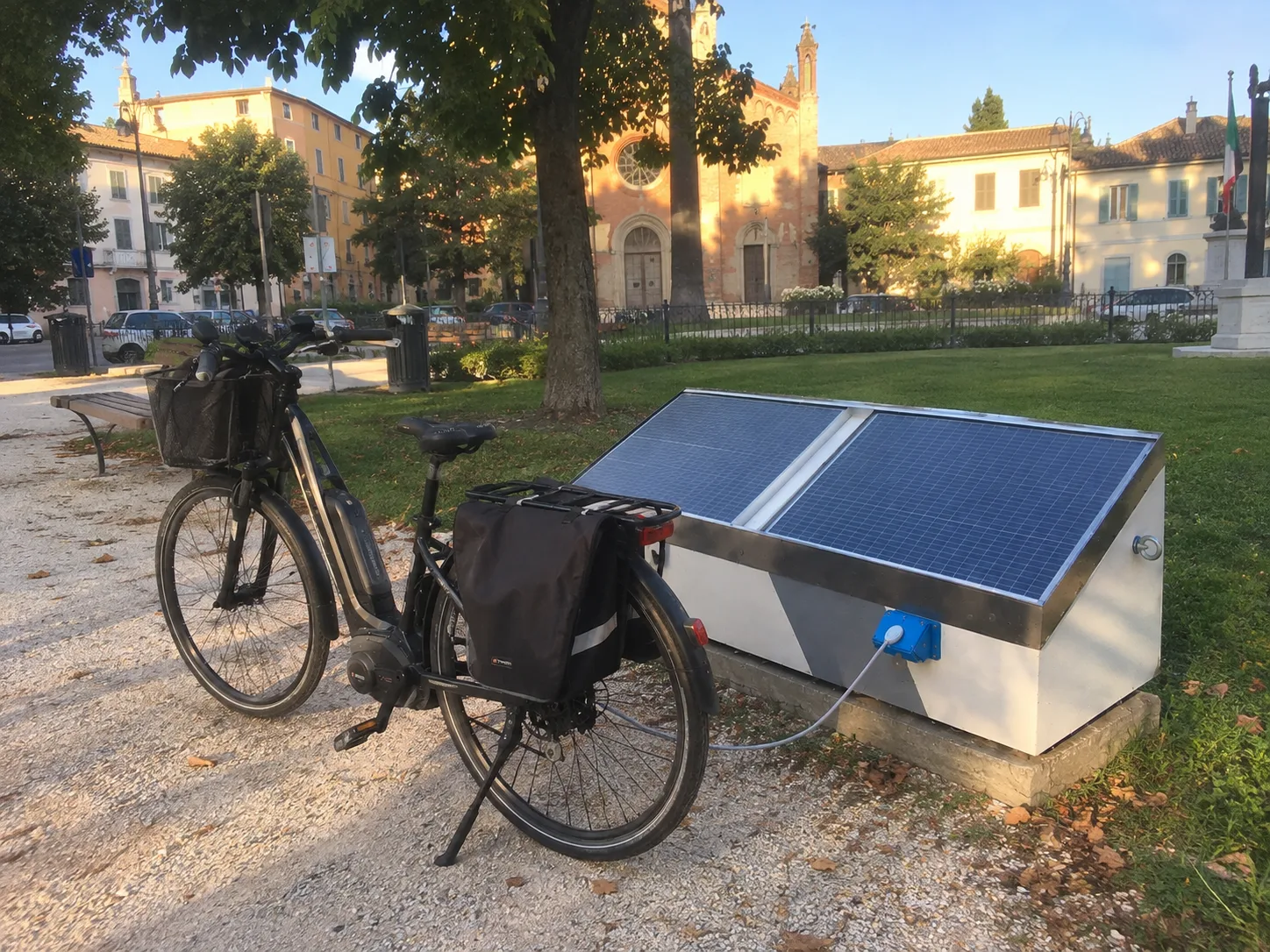
An e-bike charging station can become the physical part of that wider system. It does not replace mobility planning and it cannot make a territory smart on its own. It can, however, complete a cycle route, support a stop, make a mobility node recognisable and offer a service that people can see and use directly.
From a cycleway to a network of services
An effective cycleway is more than a line on a map. It must connect with people's destinations and provide the conditions that make the journey practical. Wayfinding, lighting, bicycle parking, rest areas and charging points can turn a route into a service. The configuration depends on the territory, but the principle is consistent: design continuity between movement, stopping and destination.
For municipalities and operators, it is useful to think in terms of nodes. A node may be located in a square, beside a station, at a park entrance or along a tourist route. Each node can have a different level of equipment as long as it remains recognisable and connected to the network. For an urban furniture manufacturer, this creates an opportunity to propose modular, repeatable solutions adapted to multiple sites.
Use data without losing contact with the place
Digital functions can help understand how infrastructure is used, but they should not obscure the physical experience. Before discussing monitoring or connectivity, check that users can find the station, reach it safely and understand the service. Data is useful when it helps an operator make a decision, such as scheduling an inspection or assessing how an area is used.
A commercial proposal should distinguish available functions, optional technology and activities that require a specific configuration. Avoiding generic promises makes the project more credible. The goal is not to prove that every element is connected, but to show how infrastructure, information and management can work together to improve cycling mobility.
Where to place smart-city solutions
Cycling-mobility solutions can be considered in urban centres, parks, campuses, industrial districts, tourist areas and mobility hubs. In a town centre, the relationship with pedestrians, shops and public transport matters. In a park, routes, lighting and maintenance matter. In a tourist area, identity, welcome and maps matter. On a campus, the frequency of use throughout the day becomes a central consideration.
There is no single correct location for every context. The project needs a review of flows, available space and the organisation that will manage the site. Solar exposure must also be checked when the system is designed around solar power, including shade, orientation and seasonality. Design should be based on site information rather than applying one standard configuration everywhere.
| Setting | Service | Objective |
|---|---|---|
| Interchange node | Parking and charging | Connect cycling and public transport |
| Urban park | Rest and wayfinding | Improve the visitor experience |
| Campus | Charging for users | Support everyday journeys |
| Tourist area | Service for cycle tourists | Strengthen the destination |
Design for accessibility and safety
A smart-city solution must work for different people, bicycles and levels of familiarity with technology. Access, instructions, manoeuvring space and connections should be clear. The installation should not narrow paths or create obstacles. Public locations also require attention to lighting, visibility, impact protection, weather resistance and intervention access.
These are not secondary details. They influence user trust and the lifetime of the project. An element that is hard to reach or understand will be used less, while a well-positioned station integrated with the rest of the furniture communicates reliability. Technical quality should therefore accompany technological quality from the first proposal.
A B2B proposal for manufacturers and designers
An urban furniture manufacturer can present smart-city solutions as part of a wider offer. The e-bike station can be shown alongside bike racks, shelters, benches, lighting and wayfinding. A designer can use it as a component of an urban concept, while a municipality can assess it as a visible service for a specific area. The language changes for each audience, but the documentation must remain consistent.
A useful commercial sheet explains use cases, requirements, configurations, installation, management and maintenance. Images, drawings and application examples help move the product from discussion to project. Unverified financial returns and incentives should not be promised. The value lies in integrating the solution into a mobility programme and creating a differentiated offer.
Manage the service over time
An effective smart city considers infrastructure lifecycle. Before installation, decide who will clean, inspect, repair and update the station. If charging is paid, assistance, user communication and transactions must also be addressed. If it is free, maintenance and responsibility are still required. The model depends on the site and cannot be assumed.
Commercial sustainability should be assessed with real information: expected use, installation, support, energy, spare parts and management costs. A guaranteed return should not be promised. A transparent project can instead define usage indicators and periodic checks that help the operator understand whether the service meets its original objectives.
Cordolo as infrastructure for a more connected city
Cordolo can be considered as a physical element within a cycling-mobility strategy. Its role depends not only on charging, but on how the station is located, signed and managed. A well-built project connects it with the cycle network, the services of the site and the people who will use it.
For an urban furniture manufacturer it is a reference to take into projects, not simply a product to display. For a designer it is a component to assess alongside space, materials and flows. For a municipality it is a possible service within a wider vision. This is how smart-city solutions become concrete and commercially useful.
How to start a smart cycling-mobility project
Start by selecting an area and describing its need clearly. Collect the plan, photographs, flows, users, constraints, exposure and objectives. Define the role of the service, compare one or more configurations and prepare documents for the designer and technical office. Only then address installation, management and support.
This method reduces the risk of choosing an unsuitable solution and makes it easier to involve partners, municipalities and operators. A smart city does not begin with one object, but with a shared design decision. An e-bike charging station can be a practical starting point when it is part of a clear, accessible and maintainable network of services.
When speaking with a public authority, translate the concept into verifiable requirements. The proposal can specify dimensions, materials, anchoring, power supply, installation conditions, accessibility and maintenance timing. It should also distinguish what is included in the supply from what depends on the site or on other parties. This clarity helps the technical office and reduces ambiguity when different offers are compared.
Indicators should also be selected carefully. Usage, service availability, reports, response times and the condition of the structure are observable elements. They are not promises of financial performance, but tools for understanding whether the service works and how it can improve. In a pilot project, this information can guide a later network extension without turning one installation into a general promise.
The furniture component can also create a shared identity. Materials, colours, signage and proportions should relate to existing elements, especially in historic centres and valuable public spaces. A recognisable solution that still belongs to its setting makes the service easier to find and contributes to visual quality. This is also relevant to tenders and specifications that assign value to landscape integration.
A good project file should make alternatives visible. It can compare a basic service point with a more complete node, explain which works are needed on site and identify the decisions that must be taken by the authority. This helps procurement teams evaluate the proposal on more than a product photograph. It also gives designers a clear basis for adapting the solution to different streets, parks and mobility hubs while preserving a consistent service concept.
- Define the area, users and objective
- Collect site data and constraints
- Choose the configuration and location
- Integrate signage and furniture
- Define management, maintenance and responsibility
FAQ
What are smart-city solutions for cycling mobility?
They are infrastructure and services that make cycling easier, clearer and more manageable in cities and territories.
Is one e-bike station enough to create a smart city?
No. It is one component that must be integrated into a network of routes, services, information and management.
Where can it be used?
At interchanges, parks, campuses, tourist areas, industrial districts and other public or shared-use locations.
Does the project need data and connectivity?
Not always. Digital functions should be assessed against the real objectives and operating model of the service.
What is the urban furniture manufacturer's role?
To integrate the infrastructure into its catalogue, support designers and municipalities and coordinate it with other urban elements.
Ready to get started?
Request a free consultation: we'll call you back within one business day with datasheets, a quote and location advice.