
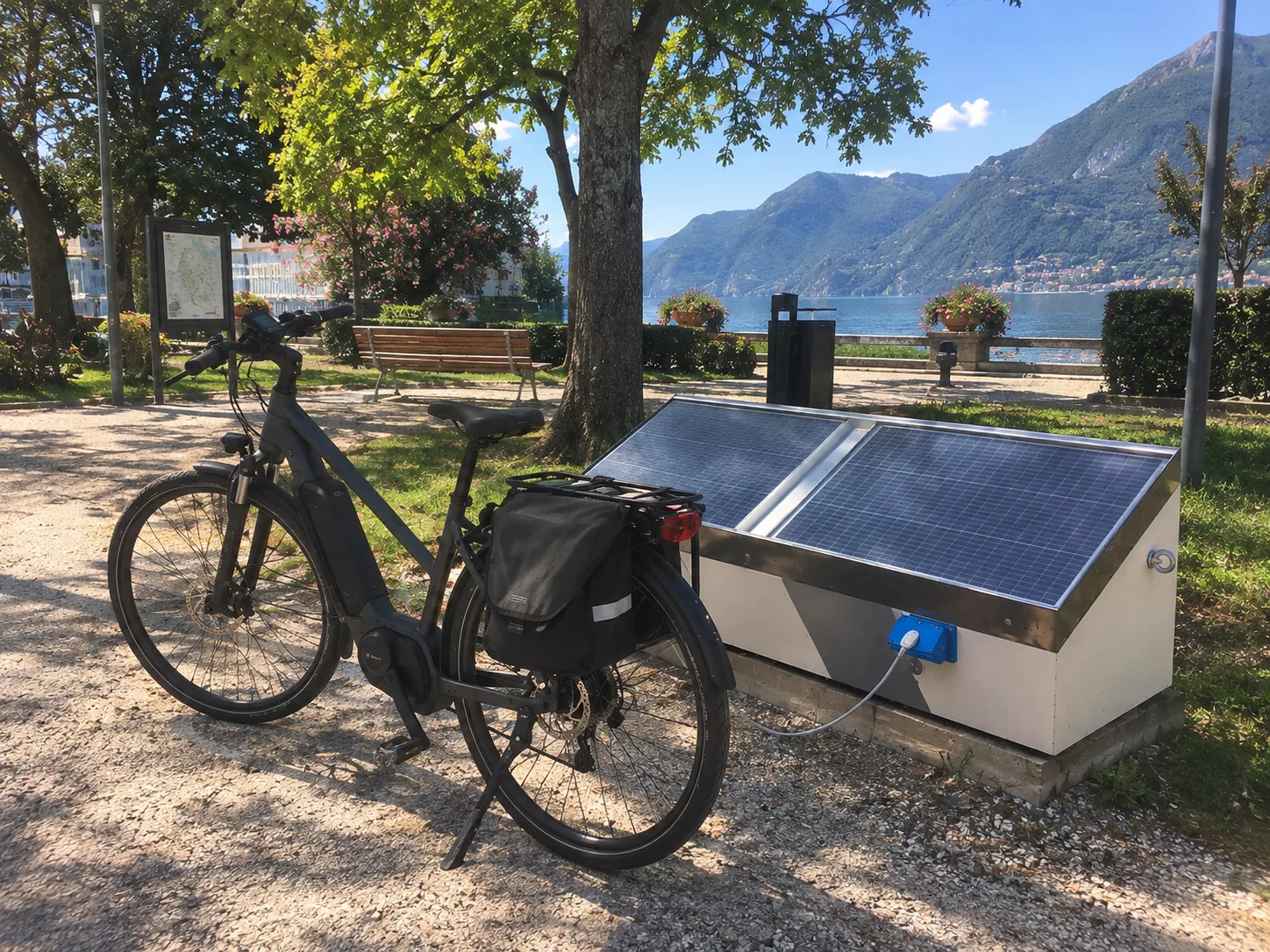
What smart urban furniture really means
Smart urban furniture is often used as a label for products that include technology, but technology alone does not make a place smart. An element becomes genuinely smart when it answers a real need, is simple to use, fits into the project without creating unnecessary complexity and supports a more informed way of managing the site. An e-bike charging station, an equipped shelter or an information point can therefore be part of smart urban furniture even when its most important feature is physical and visible.
The starting point should be the behaviour the project wants to support, not the device itself. A municipality may want to make a cycleway more attractive, a park may need a service for visitors, and a campus may want to support everyday cycling. The product belongs in the project when it helps address one of these needs. This is what separates useful urban design from a catalogue of disconnected technology.
Why services should be planned from the beginning
A common mistake is to consider services only after paving, lighting and the main furniture have been selected. At that point, available space may be limited, connections become difficult and the new element can look like an afterthought. When the function is discussed during the concept stage, designers can assess circulation, accessibility, visibility, shade, maintenance and the relationship with the rest of the site. The result is more coherent and easier for people to understand.
For an urban furniture manufacturer, this means entering the commercial conversation earlier. The offer is not just a finished object, but a project possibility: a charging point, an equipped seat, an information feature or a combination of services. The proposal can be adapted to the site and supported with drawings, datasheets and installation guidance. The catalogue becomes a tool for building projects rather than a list of references.
E-bike charging as a visible urban service
Electric bicycles have extended the reach of cycling. Riders can cover longer distances and manage hills or daily commutes that might otherwise require a car or another mode. This makes charging and stopping points relevant in places where people already pause: parks, cycle routes, tourist areas, campuses, stations and mobility hubs. Charging should not be treated as an isolated device, however. It works best as part of a wider experience of the place.
A well-positioned station also communicates the purpose of the site. It shows that light electric mobility has been considered in the design and gives users a clear reason to stop. For the client, that visibility can be part of the project's value. There is no need to promise guaranteed savings or financial returns. The benefit to assess is the quality of the service and its fit with the objectives of the intervention.
Which settings can become smart
Smart urban furniture can be used in very different settings. In parks it can support walking and cycling routes with rest points, lighting and services. In historic centres it may need dimensions and finishes that respect the surrounding landscape. In tourist areas it can become part of the visitor experience alongside maps and wayfinding. On campuses and at companies it can support everyday travel for staff, students and visitors.
The same solution has a different role in each setting. A station along a cycle route must be visible and easy to reach; on a company site it may be integrated with access and facility services; at a campsite it should fit the site's paths and operating model. The product should therefore not be sold with only one standard configuration. Its commercial value comes from adapting it to the project while keeping use and maintenance clear.
| Setting | Possible service | Design priority |
|---|---|---|
| Public park | Rest, charging and wayfinding | Accessibility and route integration |
| Cycle route | Service point for riders | Visibility, safety and maintenance |
| Campus or company | Service for users and employees | Everyday use and management |
| Tourist area | Welcome and low-impact mobility | Visual coherence and communication |
Designing for people, not only for objects
An urban service should be understandable to someone using it for the first time. The location should be intuitive, access routes clear, instructions readable and essential operations easy to recognise. With an e-bike station, designers should consider where the bicycle rests, how the connector is reached, what happens during charging and who to contact if something goes wrong. These details affect perceived quality more than a complex technology description.
Accessibility also concerns the wider setting. The installation should not narrow a path, create a trip hazard or force awkward manoeuvres. Surfaces, weather protection, night-time visibility and resistance to intensive use should be assessed together with the form. When these conditions are considered from the start, smart furniture feels natural instead of becoming an obstacle in public space.
The role of the urban furniture manufacturer
A manufacturer can turn smart urban furniture into a real catalogue opportunity by offering more than the physical product. Buyers need support with selection, technical drawings, installation guidance, maintenance information and possible customisation. These materials help a designer include the solution in a specification and help a salesperson explain its value to a municipality, operator or general contractor.
Working with a specialist partner can also expand the offer without requiring the manufacturer to build every capability internally. The urban furniture company keeps the client relationship and presents the station as part of the project; the partner supplies technology, documentation and technical support. Clear responsibilities matter. Buyers should know who handles installation, service, spare parts and project requests before approval.
How to assess a project before making an offer
Before adding a smart element to a proposal, collect basic information about the site. Who will use it, at what times, how often and for how long? What space is available, how much sun reaches it, how do people move through it, and how will maintenance be carried out? The operating model should also be clear. Will the service be free, run by an operator, included in a venue's offer or connected to a payment system? None of these options should be assumed.
This stage does not need to slow down the sale. It qualifies the request and leads to a more credible configuration. A site visit, plan or a few photographs may be enough to start the discussion. The final proposal can then be based on information that has been checked, avoiding promises about performance, savings or results that depend on unknown conditions.
Smart urban furniture in public tenders
In a tender, a smart solution should be described in practical terms. The proposal should explain the need, the service, the relationship with the site and the maintenance model. Images are useful, but they do not replace datasheets, dimensions, materials, installation methods and operating information. It is also helpful to distinguish standard elements from customisable ones, so the client can compare offers transparently.
Innovation should not be used as a decorative word. A charging station matters because it adds a real function to a cycleway or equipped public space, not because it contains technology in the abstract. The strongest proposal always connects the product to an objective: support a stop, encourage electric mobility, complete a service or improve the quality of use of the site.
From catalogue item to urban infrastructure
For an urban furniture company, the important step is to stop treating smart solutions as occasional accessories. They can become a coherent line with design criteria, images, datasheets and recognisable configurations. This makes it easier to train the sales network and to build modular proposals for municipalities, designers, parks, hospitality sites and companies.
Cordolo can fit this approach as a component dedicated to light electric mobility. Its role should be assessed with the site, exposure, users and operating model in mind. The result is not the sale of a solar panel, but a proposal for urban infrastructure that completes a place and opens a new commercial conversation. Smart urban furniture becomes concrete when technology serves the project and the people who use it.
FAQ
What is smart urban furniture?
It is a set of elements and services designed to make public space more functional, accessible and useful. Technology is a tool, not the primary goal.
Can an e-bike station be smart urban furniture?
Yes, when it is integrated into a coherent project with a clear purpose, accessibility, operating model and maintenance plan.
Where can it be installed?
Possible settings include parks, cycleways, squares, campuses, companies, tourist areas, campsites and mobility hubs, subject to site review.
Does the service have to be paid?
No. The operating model depends on the setting and should be assessed against users, costs, maintenance and responsibilities.
How can a manufacturer add it to a catalogue?
As a dedicated line or as part of broader proposals including shelters, bike racks, lighting and other urban elements.
Ready to get started?
Request a free consultation: we'll call you back within one business day with datasheets, a quote and location advice.