
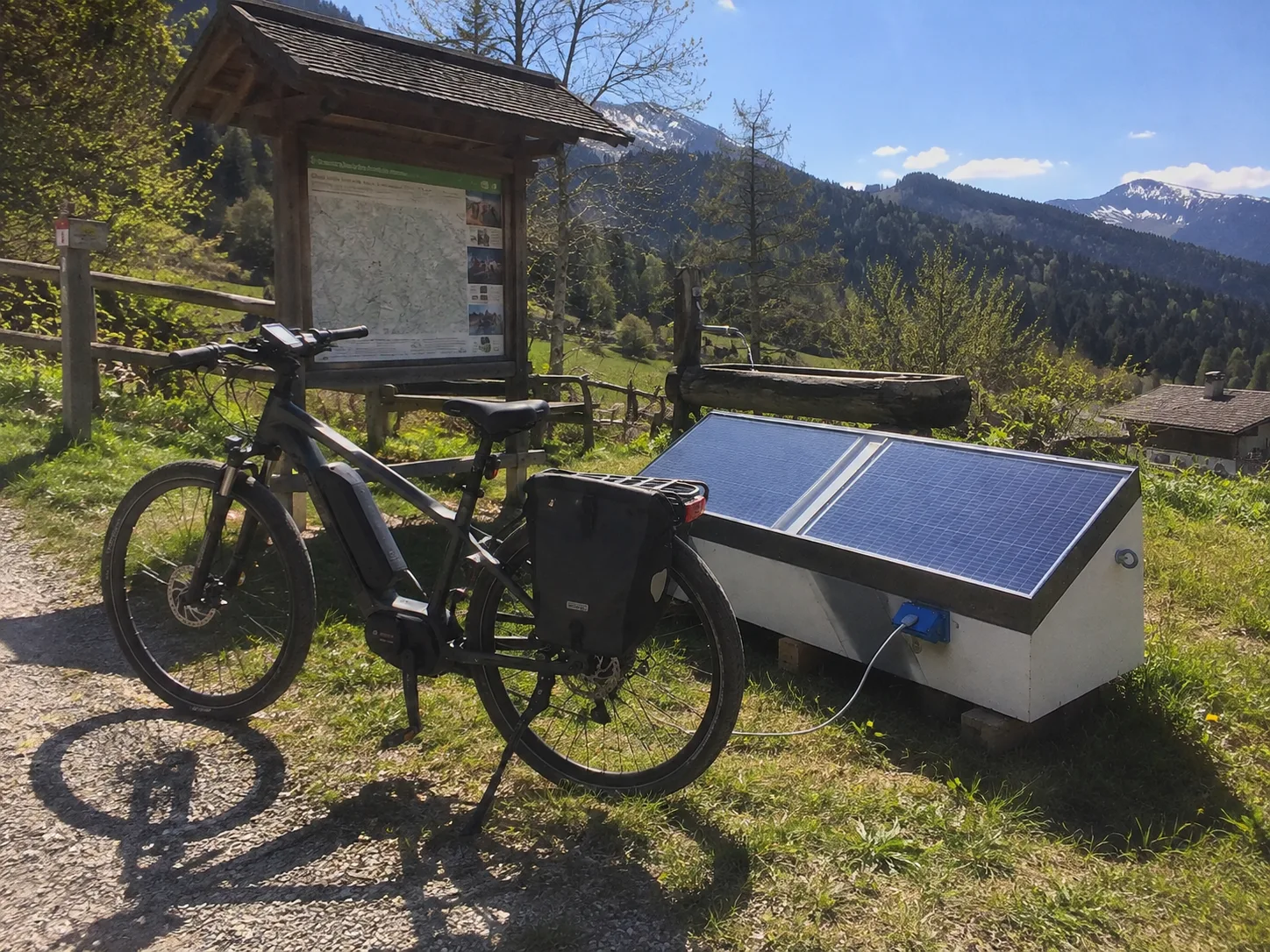
Why plan e-bike charging in public spaces
Electric bicycles have changed how many people move through cities and tourist regions. Compared with a conventional bicycle, an e-bike makes longer distances, hills and everyday commuting more accessible. Cycleways, routes and stopping areas can therefore become a network of services rather than simple corridors. A charging station placed in the right location gives riders a practical reason to stop and makes the route more complete.
The decision to install a station should not begin with the product trend. It should begin with the site, its flows and the service the client wants to provide. A municipality may want to improve a cycleway, a park may want to strengthen visitor services, and a tourism operator may want to connect cycling with the rest of the venue. Each objective requires attention to location, accessibility, operating model and maintenance.
Where to place a charging station
Location determines much of a station's usefulness. Along a cycle route it may sit near a viewpoint, rest area or connection with another route. In a park it can relate to benches, drinking fountains, lighting and maps. In a square or town centre it should be visible without obstructing movement. Near a railway station or mobility hub it can connect cycling with public transport and make the transition between modes easier.
Private sites open to a wider community can be equally relevant: campuses, companies, hotels, campsites, resorts and sports facilities. The operator often has more control over access, assistance and maintenance, but the same public-space principles still apply. Access should be clear, the station should be protected from weather and misuse, and interventions should be possible without disrupting the site's normal circulation.
| Setting | Main function | Key checks |
|---|---|---|
| Cycleway | A stop during the journey | Visibility, safety and accessibility |
| Public park | A service integrated with recreation | Routes, lighting and maintenance |
| Tourist area | A welcome service for visitors | Visual fit and operating model |
| Campus or company | A service for users and staff | Everyday use and responsibility |
| Mobility hub | A link with other transport modes | Flows, space and wayfinding |
How to choose the right point in the project
A good installation point is easy to find and reach without conflicting with pedestrian routes or emergency access. The plan should show how bicycles arrive, where they are parked and how users move around the structure. Ground conditions, drainage, fixing and protection from accidental impacts also need attention. These details are less visible in a sales presentation, but they are decisive during implementation.
A solar solution also requires an assessment of exposure. Shade from trees, buildings, shelters or other furniture can change system behaviour throughout the day and across seasons. It is not accurate to promise the same performance in every location. Sizing must be checked against site data, the available configuration and the expected use profile.
Outdoor solar charging: what to communicate accurately
Outdoor solar charging is attractive because it brings the service close to the user and may be considered where a new grid connection is difficult. Solar should not, however, become a shortcut for promising unlimited energy, zero costs or guaranteed savings. Exposure, orientation, seasonality, storage, user numbers and charging patterns all influence the outcome. Communication should distinguish what is available as a product from what must be verified in the project.
A useful datasheet explains configurations, installation requirements, operating limits and maintenance. Designers also need dimensions, materials, protection, foundations, connections and access information. Operators need to know how faults, cleaning and support will be handled. Precise communication builds confidence and reduces the risk of including a station in a specification with unrealistic expectations.
Integrating the station with urban furniture
An e-bike station should not look unrelated to its surroundings. Materials, colours, proportions and graphic language can be coordinated with benches, bike racks, shelters, bins, lighting and wayfinding. Integration does not mean making every object identical. It means creating a visual and functional relationship. A station beside a map can clarify the route; a shelter can improve comfort; a rest area can increase the quality of the whole stop.
Information is part of the infrastructure. Users need to know what they can do, where to connect the bicycle, whether the service is free or regulated, which rules apply and who to contact if there is a problem. Simple signage consistent with the rest of the area removes uncertainty. When communication is planned with the structure, the service feels more reliable and the client can manage the experience more effectively.
Management, maintenance and responsibility
Every e-bike charging project should clarify who is responsible after installation. The municipality may manage it, the site owner may take responsibility or a specialist operator may be appointed. In every case, there should be procedures for cleaning, inspection, support and repair. A public installation is exposed to rain, dust, intensive use and possible vandalism, so inspection access and spare-parts availability are design considerations rather than afterthoughts.
If the service involves payment, the project raises additional questions: how are users identified, how is assistance provided, who manages receipts and how are conditions communicated? There is no universal model. Commercial sustainability must be assessed against expected demand, costs, maintenance, local rules and operational responsibility. A charging station should never be presented as an automatic source of profit.
How to present the solution to municipalities and designers
A strong proposal starts with the problem the project must solve rather than a list of features. The supplier can ask what role the station will have in the cycling network, who will use it, which area needs improvement and how the service will be managed. Configuration, drawings, finishes and documentation follow from those answers. The result is easier to understand for a client who has never worked with the product before.
Municipalities care about reliability, maintenance, accessibility and clear responsibilities. Designers need dimensions, materials, installation, safety and integration options. Operators focus on service continuity, support and operational control. The same product should therefore be explained with different arguments, while technical data remains consistent and a project possibility is not turned into a commercial guarantee.
A new catalogue category for urban furniture companies
For an urban furniture manufacturer, e-bike charging can become a new category to present alongside cycling infrastructure. The opportunity is not simply to sell a single column. It is to participate in wider projects where the client wants a coordinated solution. A catalogue can show configurations, use cases, installation methods and customisation options, giving the sales network concrete tools for new conversations.
Cordolo can be considered in this way: as infrastructure to integrate into a public or shared-use site. The final choice depends on the setting, configuration and client's objectives. The strongest offer combines service, design, documentation and management. That is how e-bike charging becomes part of sustainable urban furniture rather than an isolated object without a defined role.
The sales conversation should also make the next steps easy to understand. A manufacturer can start with a short project brief, request the site plan or photographs, identify the expected users and then involve the technical team. This sequence gives the client a clear path from initial interest to a realistic configuration. It also creates a better basis for discussions about delivery, installation, service levels and future expansion. When the station is presented as part of a repeatable project process, it becomes easier to include in tenders, framework agreements and multi-site programmes without treating every request as a completely new product.
A pre-installation checklist
Before confirming a project, collect the essential information in one document. The checklist should cover location, access, dimensions, exposure, expected users, charging configuration, power, foundations, protection, signage, maintenance and the operating contact. On a public site, permissions, restrictions, responsibilities and compatibility with local rules should also be checked.
The checklist does not replace technical design, but it helps everyone work from the same information. It avoids proposing an unsuitable solution, makes the quotation clearer and allows the next activities to be planned accurately. For an urban furniture manufacturer it is also a sales tool: it demonstrates attention to context and turns a general enquiry into a professional assessment process.
- Setting, flows and expected users
- Available space, accessibility and safety
- Solar exposure and ground conditions
- Configuration, installation, power and protection
- Management, maintenance, support and responsibility
FAQ
Where can an e-bike charging station be installed?
On cycleways, bike routes, parks, squares, tourist areas, campuses, companies, campsites and mobility hubs after a site assessment.
Will solar charging work in every location?
Performance depends on exposure, shade, configuration, season and use. The site should be reviewed before installation.
Who manages the station?
The municipality, site owner or an appointed operator may manage it. Roles and maintenance should be defined in the project.
Can charging be paid?
It can be considered case by case, taking technology, rules, operating costs, demand and operator responsibility into account.
What should a municipal proposal include?
The service function, location, configuration, technical documents, installation, maintenance, accessibility and operating model.
Ready to get started?
Request a free consultation: we'll call you back within one business day with datasheets, a quote and location advice.