
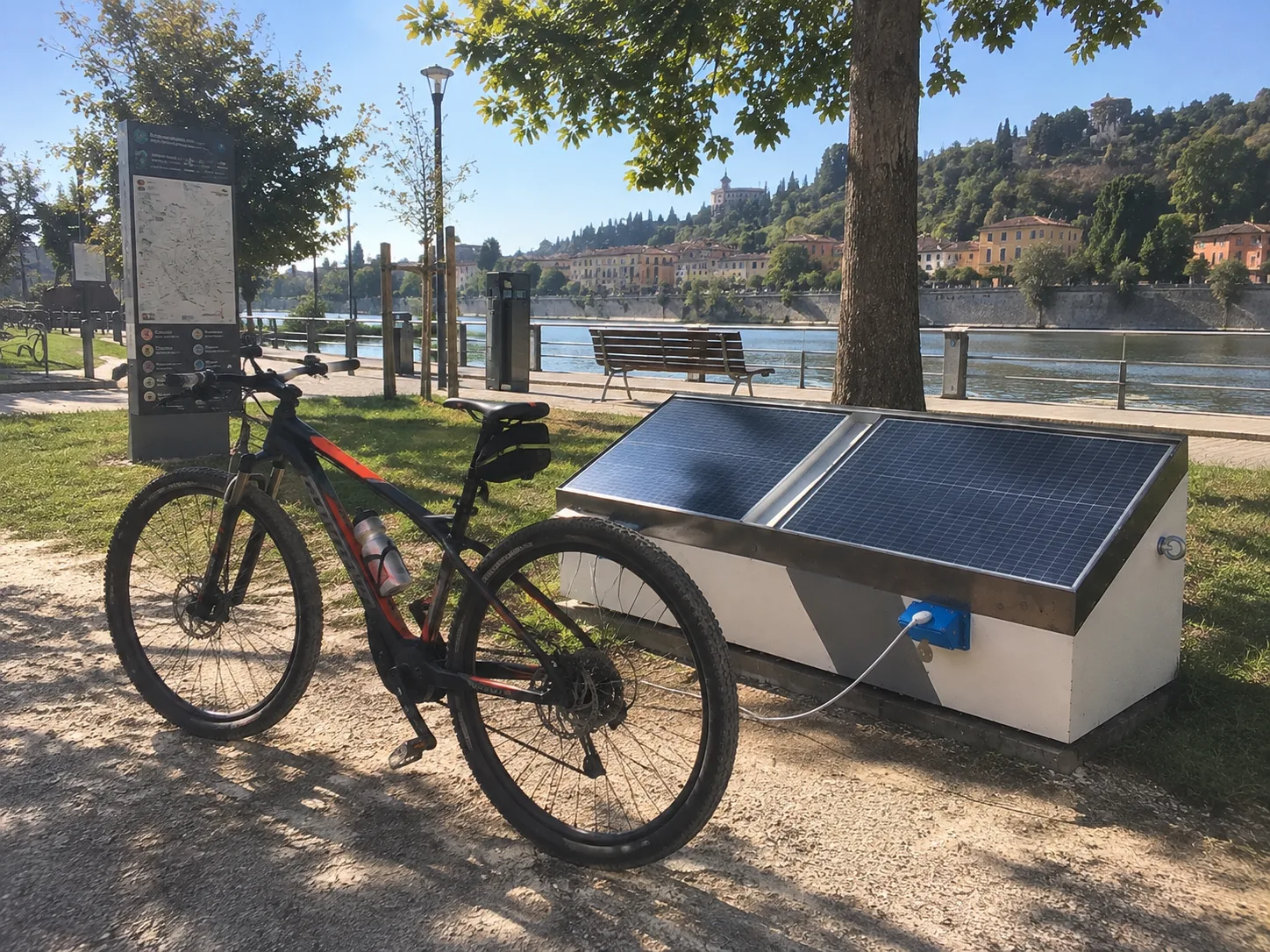
Sustainable mobility is becoming part of urban design
Proposing sustainable mobility infrastructure to a municipality or design practice requires a different approach from selling a catalogue product. The client is not simply looking for a charging column or a solar panel. They are considering how to make a route, park, square or interchange more complete. The proposal must therefore begin with the project and the service the infrastructure can provide.
For an urban furniture manufacturer, this creates a practical opportunity. An e-bike charging station can expand the catalogue and open conversations with technical departments, designers, park managers, transport companies and tourism operators. Its value is not an automatic financial promise. It is the possibility of adding a new function to public space and participating in more complete infrastructure projects.
Understand who decides and what problem must be solved
The first commercial step is to understand who is involved in the decision. A municipality may define objectives and budget, a designer may turn them into drawings and specifications, an operator may run the service and a general contractor may coordinate supply. Each stakeholder views the same solution differently. An effective proposal has to address these perspectives instead of speaking to only one person.
Before presenting Cordolo, ask what area needs improvement, who will use the service, how often, at which point in the journey and under which operating model. The answers separate a real project need from general curiosity. They also help select relevant images, data and arguments, avoiding a presentation full of features that do not help the client make a decision.
Turn a general enquiry into a project brief
A request such as “we are looking for an e-bike station” is only a starting point. A project needs context and constraints: a plan, available dimensions, exposure, access, flows, existing furniture, ground conditions and maintenance requirements. A few photographs may show whether the solution will sit along a cycle route, in a square, under a shelter or next to a building.
The brief should also describe the intended outcome without confusing it with a guaranteed financial result. The client may want to improve cyclist services, make a cycleway recognisable, strengthen a tourist area or connect cycling with public transport. Defining the objective creates a logical basis for selecting the configuration and writing a technical proposal.
Build a credible technical proposal
A technical proposal should be readable for someone who has never worked with the product. It can begin with the site's need, explain the proposed solution and then show how it fits the project. Product characteristics, materials, dimensions, installation, power, protection and maintenance follow after that. The order matters: the client should first understand why the solution is relevant and then check whether it meets the requirements.
Images help people imagine the result, but they do not replace documentation. Dimensioned drawings, datasheets, connection information, component descriptions and installation conditions are all useful. If customisation is available, it should be stated accurately. Finishes, colours, branding, configurations and accessories should not be presented as standard if they require a separate assessment.
- Project objective and expected users
- Solution description and installation context
- Dimensions, materials, installation and technical requirements
- Management, maintenance and support
- Standard configurations and customisation options
Present Cordolo in a specification or tender
A specification should be precise, verifiable and based on functional requirements when the client is not asking for a single brand. It is useful to work with the designer to translate the product into requirements covering structure, intended use, charging points, resistance, accessibility, installation and documentation. The supplier can provide data and drawings while the designer remains responsible for the final wording of the document.
In a tender, the differentiator can be the completeness of the proposal. A station connected to a mobility strategy, the quality of the public space and a management plan is easier to understand than an object described by a photograph alone. Incentives, savings and guaranteed returns should not be promised without evidence. It is more accurate to describe the service and identify which aspects the client must verify.
The value of integration with urban furniture
A charging station gains value when it relates to the elements already present. Bike racks, benches, shelters, lighting, bins and wayfinding can create a recognisable system. Integration also concerns movement: users should be able to arrive, stop, charge and leave without conflicts with pedestrians or vehicles. For that reason, the solution should be shown in a plan rather than only against a neutral background.
For an urban furniture manufacturer, offering a coordinated system increases the relevance of the catalogue. The client can work with one partner who understands the project, while the technology partner contributes specialist expertise. The result is a broader B2B offer that can support tenders, redevelopment works, tourist areas and programmes distributed across multiple sites.
Management, maintenance and lifecycle
Municipalities and designers increasingly assess what happens after installation. A proposal should explain who inspects the structure, how cleaning and faults are handled, what support is available and which parts can be replaced. Outdoor conditions, intensive use and vandalism make component access and spare-parts availability important. A well-designed product loses value if after-sales responsibility is unclear.
The operating model should be defined before delivery. Charging may be free, included in a venue's services or regulated by a payment system where technically and commercially appropriate. Each option involves different responsibilities and costs. A responsible proposal explains them without suggesting that the service will automatically generate profit. Sustainability must be assessed against the site and expected use.
Help the client make a decision
The supplier's role is not to push a configuration before understanding the site. It is to reduce uncertainty. A clear process can include an initial discussion, collection of available data, technical review, one or more options and a clear explanation of installation and management. This makes the decision more transparent and allows incompatibilities to be identified early.
For an urban furniture manufacturer or reseller, the process also becomes repeatable. An information form, a set of WebP images, a standard drawing and a technical checklist help the sales network work with greater independence. Consistent material allows the product to be presented to different stakeholders without losing precision or turning it into a generic smart-city promise.
From a first proposal to a B2B partnership
A single supply can become the start of a broader collaboration. An urban furniture manufacturer may add Cordolo to its catalogue, propose it in several tenders or develop configurations for different sites. A design practice may need a technical contact for multiple municipalities. An operator may assess a repeatable solution for parks, hotels or cycle routes.
Building that relationship requires clarity and continuity: current documentation, response times, customisation options, tender support and after-sales service. The aim is not to sell an abstract technology, but to make it easier to include sustainable mobility infrastructure in real projects. This is the strongest commercial position for Cordolo and the partners who bring it to market.
Checklist for presenting to a municipality
Before sending a proposal, check that the document answers the client's essential questions. Where will the station be installed? Who will use it? What service does it add? How will it be installed and managed? What maintenance is required? Which data is confirmed and which depends on a site review? A proposal that makes these points explicit is easier to assess and easier to turn into an executable project.
The process can end with a technical call, a site visit or a request for the documents needed for a specification. The call to action should also be concrete: not “discover the technology”, but “assess how to integrate the solution into your urban furniture project”. The language should remain professional and natural for a B2B stakeholder who must make a shared decision with several other parties.
It is also useful to define the handover between the parties. The municipality can provide the project objectives and local requirements, the designer can coordinate layout and compliance, and the supplier can confirm the product configuration and installation data. Agreeing on this sequence prevents gaps between the commercial offer and the final design. It gives every stakeholder a clear responsibility and makes the proposal easier to review, update and replicate in future locations.
- Site brief and intervention objective
- Plan, photographs and site constraints
- Datasheet and installation drawings
- Management and maintenance model
- Commercial and technical contact for the next stage
FAQ
Who should be offered an e-bike charging station?
Municipalities, design practices, park managers, transport companies, tourism operators, companies and general contractors.
How is it included in a specification?
By describing functional requirements, configuration, installation, accessibility, maintenance and documentation in a verifiable way.
What information is needed before making an offer?
The setting, users, location, space, exposure, flows, operating model and technical or regulatory constraints.
Is it correct to promise a financial return?
Not without verifiable data. Any paid model and its sustainability must be assessed for the specific site.
What role does the urban furniture manufacturer play?
It can integrate the station into its catalogue, coordinate project elements and offer it through its sales network with technical support.
Ready to get started?
Request a free consultation: we'll call you back within one business day with datasheets, a quote and location advice.