
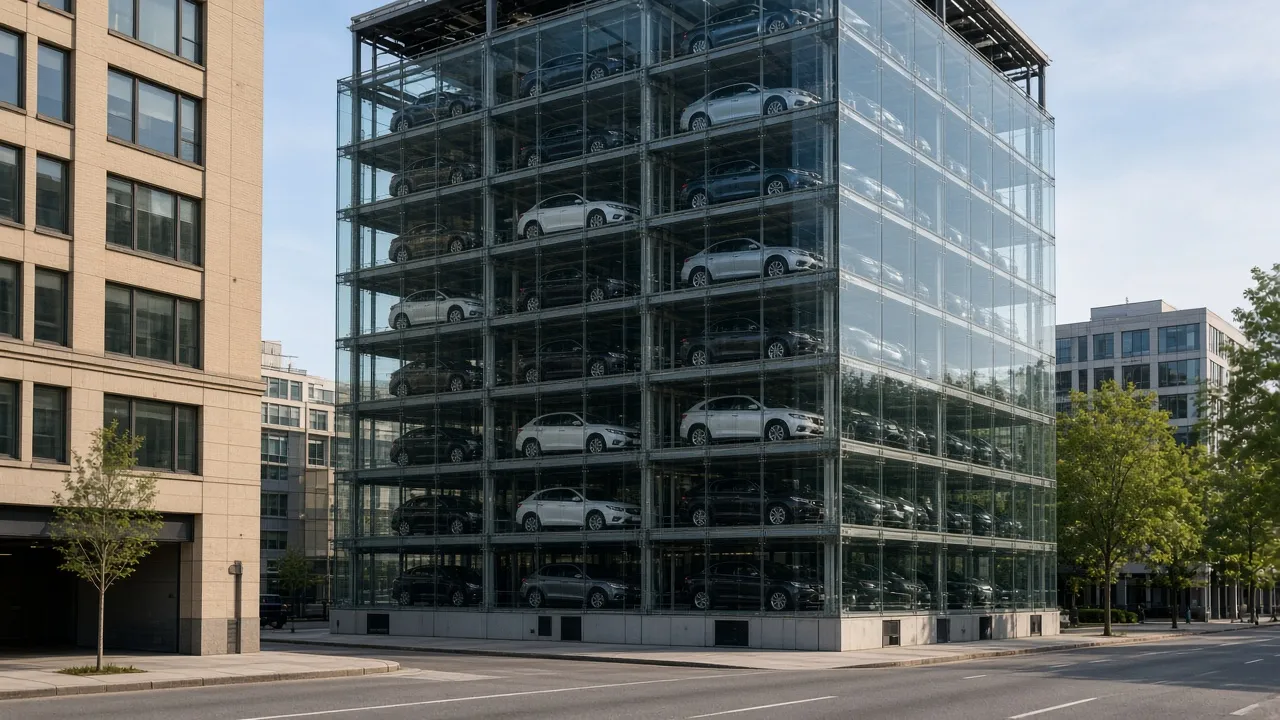
Car vending machine ≠ the snack machine in the service lounge
Searchers typing «car vending machine», «vehicle vending tower» or «Carvana vending machine» usually mean a glass tower that delivers a car you already bought online — not the coffee and snack vendor beside the tyre bay. This guide covers automated vehicle towers; for waiting-area refreshments see our car dealership vending sector article.
The «vending» label is experiential marketing: you do not buy a random car like a chocolate bar. The real flow is closed e-commerce → appointment → ID check → (often) a commemorative coin that starts the internal carousel → car in a delivery bay within minutes.
Europe’s best-known precedent is Volkswagen’s Autostadt in Wolfsburg — cylindrical towers around 48 m tall where robots store and retrieve new cars. Online retailers such as Autohero run pickup hubs without public glass towers, yet «car vending» remains a high-volume SEO topic for automotive innovation watchers.
How a tower works: from checkout to keys
Digital purchase: browse, finance, contract and warranty online; the tower appears only at pickup. In the US, Carvana also offers home delivery — the tower is an optional showpiece.
Transport and staging: the vehicle is inspected, detailed and loaded into a slot before the customer slot.
Customer arrival: advocates or kiosks verify ID and any remaining paperwork; some sites are largely self-service.
Coin / token drop: the customer inserts the token; the control system starts lifts and horizontal transfer — the same principle as automated multi-storey car parks (puzzle parking) used in dense Asian and European cities.
Handover: the car reaches a lit bay; lights and damage walkaround, then drive-away. Operators often quote under five minutes after the trigger.
- Online purchase before tower use
- Per-vehicle slot with tight clearances
- Carousel / lift with no driver inside tower
- Smaller on-site staff vs traditional lots
- Street-visible iconic branding
Engineering: height, capacity, safety
US Carvana towers are commonly 8–12 storeys of steel and glass, holding on the order of 20–30+ vehicles depending on design (recent permits describe ~75 ft structures with several cars per upper level plus customer-care offices).
Mechanics: motorised platforms, guides, positioning sensors, safety interlocks — storage zones are not public (wording used in building permits).
Maintenance: motor redundancy, periodic tests, fire and ventilation for enclosed bays; operating cost dwarfs a Maxima snack column.
Software: slot WMS, VIN-to-position mapping, order CRM integration; plant telemetry resembles smart vending fleets (alarms, uptime) at building scale.
| Factor | Car tower | Snack vendor |
|---|---|---|
| Ticket | £15k–40k+ | £1–3 |
| Plant CAPEX | Millions | Thousands |
| Product | Unique vehicle | Packaged SKUs |
| Rules | Planning, traffic, HSE | Food safety |
| Experience | Event / PR | Quick consumption |
Carvana and the US market (2025–2026)
Carvana popularised «car vending machine» with several dozen towers across the United States (Texas and Florida among the denser states). Each new tower is a construction programme: foundations, glazing, automation and attached customer-care centres.
Recent press: revived permits for Ohio projects (Columbus / Polaris area) combining delivery bays and the signature tower — opening dates are often undisclosed, but electrical and building permits in 2026 suggest active sites.
Towers double as marketing: social photos, coin ceremonies, skyline landmarks. Core volume still flows through regional reconditioning and last-mile logistics.
Europe and Italy: rare towers, common digital pickup
Germany: Wolfsburg Autostadt — twin towers holding up to roughly 400 cars each, linked to factory and customer centre; decades of «vending» experience for VW buyers collecting new cars.
Italy: online used-car purchase with hub pickup (e.g. Autohero locations in Bologna, Turin, Bari) — no public glass tower; inspection, 360° photos and appointment collection instead.
Few EU towers because land cost, planning law and home-delivery preference dominate; showpiece builds suit global brands with marketing budgets, not every neighbourhood dealer.
Many «car vending machine near me» queries in Italy still surface US news or dealership snack machines — content should clarify intent.
Permits, insurance and liability
Tower projects need planning, traffic impact, glazing energy performance, fire strategy and noise if open late. US permits describe automated racks with access limited to trained staff.
Liability covers mechanical damage during moves, downtime with waiting customers and cyber risk on release systems — unlike food vending liability.
Privacy: contract and customer data; marketing video in handover bays needs a lawful basis under GDPR-style rules.
Economics: when a tower is rational
Only for operators with regional online volume and real-estate marketing budget. Payback is not «more snack sales» but flagship delivery cost and PR.
Contrast: a 200-space automated underground car park serves urban density; a glass tower stores fewer cars but advertises the brand.
Traditional dealers often get better ROI from digital leads plus a comfortable lounge with Project Vending coffee and snack columns during 30–90 minute service waits.
Where Project Vending fits
We do not build automobile towers. We build Made-in-Italy vending machines for snacks, drinks, coffee and food with telemetry — installed in workshops, showrooms and EV charging lounges where customers wait.
The shared thread is automation, cashless, remote monitoring and unattended UX — skills we apply to automotive waiting areas, not 20-tonne carousels.
If you need tower mechanics, talk to automotive automation contractors; if you need dealership refreshment vending, we scope fleet and POS integration.
Trends: EV handover, micro-hubs and phygital
EV delivery: bays with chargers after automated retrieval — concept stage, not mass standard.
Urban micro-hubs: container plus lift for a handful of cars instead of an icon tower — less PR, more density.
Phygital: showroom QR to finish online purchase and collect on site without a tower — likelier near-term path in Italy.
Contact Project Vending
For dealership / workshop vending: send site count, customer type (service vs sales floor) and desired range (coffee, snacks, water).
Subject line «Dealership vending» helps us separate snack installs from «car vending tower» questions.
FAQ
Is there a Carvana tower in Italy?
No US-style public towers; online buyers use logistics hubs.
Do I pay with coins at the tower?
No — payment is online; the token only starts retrieval.
Does Project Vending sell car vending machines?
No — we supply snack and drink vendors for automotive sites.
How is this different from automated parking?
Similar mechanics; the tower adds closed-order retail and branding.
Where should snack machines go in a dealership?
Waiting lounge, service reception, EV charge area — see our dealership sector guide.
Ready to get started?
Request a free consultation: we'll call you back within one business day with datasheets, a quote and location advice.