
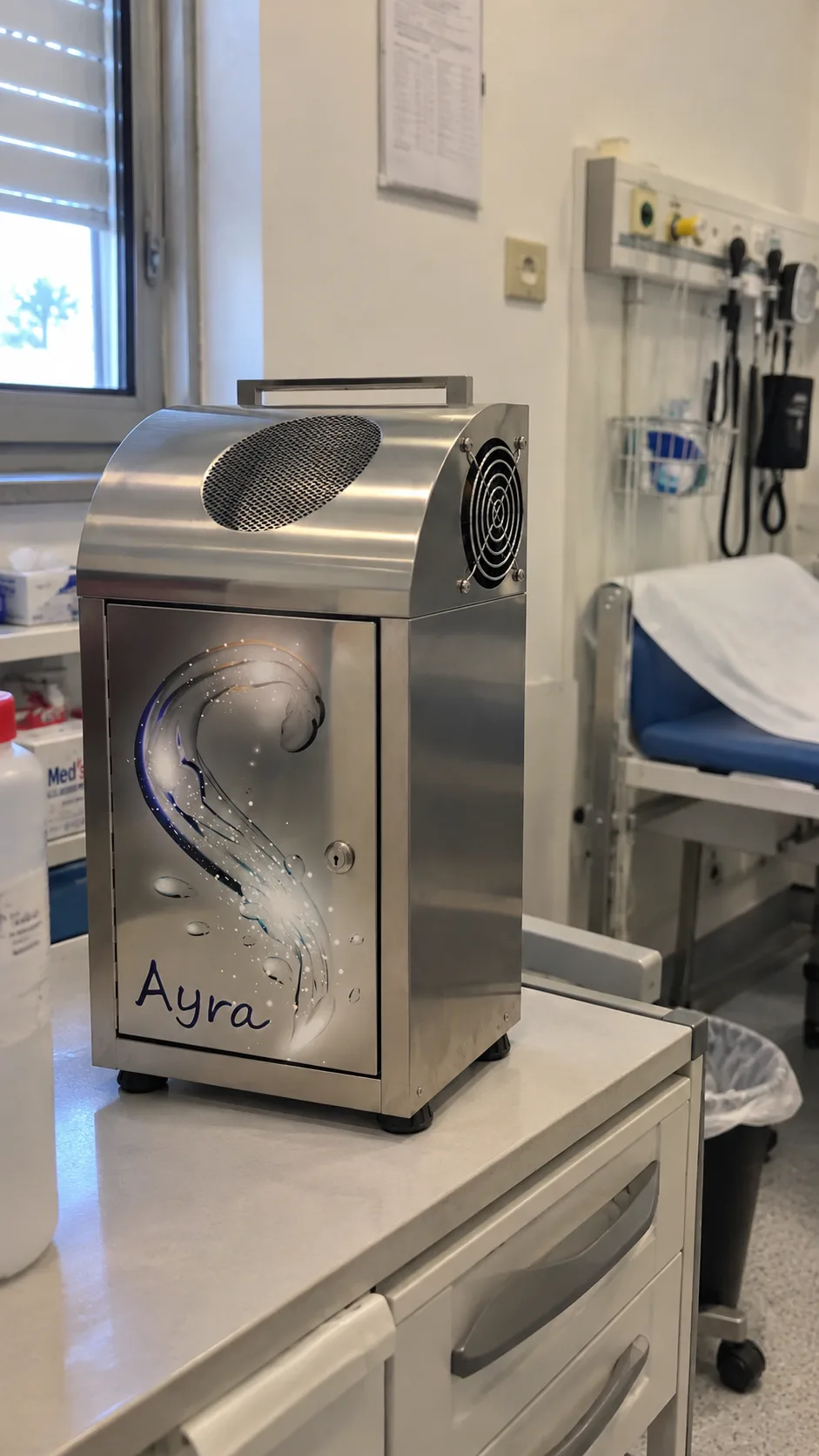
Mini does not replace the mobile fleet: it completes it
Ayra Mini weighs about 6 kg and sits on furniture: it is built to stay, not to run between floors. This operating guide explains where to place it, how to avoid installation mistakes and how to pair it with Trolley or Standard without duplicating roles. The Mini product sheet remains the reference for specs (535 × 300 × 200 mm, ≈ 240 m³/h, optional battery); here the focus is fixed points and organisation.
The typical risk is treating Mini like a tiny Trolley and moving it constantly, or leaving receptions and studios uncovered because all attention goes to room rotation. A solid protocol assigns Mini to small recurring rooms and the 20 kg units to large volumes and long routes.
Criteria to call a room a «Mini space»
A room is a Mini candidate if volume is limited, there is a stable support surface, a nearby socket and the unit will not block circulation or the guest view. Receptions, professional studios, hotel back offices, interview rooms, small changing rooms, booths and service corners often fit. If you must treat open spaces or long corridors in sequence, Mini alone is the wrong tool.
Measure shelf depth, free height and distance from paper, textiles or electronics sensitive to fogging moisture. Also check whether the cycle can run in a controlled or empty area, based on the liquid. Without these checks, even a discreet device becomes a safety or complaint issue.
- Volume and geometry compatible with ≈ 240 m³/h
- Stable support (furniture/shelf) and power socket
- Safe access during and after the cycle
- Acceptable visibility for brand/hospitality
- Owner for liquid top-up and periodic checks
Receptions and offices: discretion and opening rhythms
At reception, Mini works best outside peak hours or in scheduled slots so it does not interfere with greetings and queues. On a side shelf or technical cabinet it stays recognisable to staff without invading the desk. In offices and professional studios, cycles after closing or between appointments reduce friction; a timer or daily checklist prevents forgotten runs.
The optional 12 V 2.2 Ah battery and handle only matter if Mini must move between two nearby rooms without a cable. If the unit is truly fixed, they are often unnecessary: invest instead in stable placement and a clear liquid protocol.
Hotels and clinics: where Mini stops wasting the Trolley
In hotels, Trolley follows check-out and floors; Mini keeps fixed points covered (reception, management office, small rooms) without stealing time from room rotation. In clinics and outpatient sites, only where protocol allows, Mini can stay in non-critical consulting rooms while Trolley rotates waiting areas and restrooms. The goal is not to make the mobile device do fixed-point work.
Log position, times and liquid batch for Minis too: audits do not care whether the machine is «large» or «small» if traceability is missing. Train whoever runs the desk or studio to report anomalies (leaks, odours, cycles that did not start) so Mini does not sit powered off for weeks.
| Fixed point | Why Mini | Typical mistake |
|---|---|---|
| Reception | Discreet, off-peak cycle | Fogging during a full guest queue |
| Studio / small meeting | Furniture placement, 6 kg | Using it for whole open spaces |
| Hotel back office | Frees Trolley for rooms | Moving it daily «because it is light» |
| Allowed clinical area | Repeatable point in a studio | Using it outside hygiene protocol |
Mini + Trolley/Standard mix: one family, different roles
An effective mix assigns explicit roles: Mini = small fixed points; Trolley = multi-floor rotation; Standard = floor zones that do not need a luggage handle. Same liquid and re-entry criteria, different hardware. Staff then stop improvising «grab whatever is free» and quote sizing becomes clear.
If fixed points are many, several Minis create less operational friction than forcing one Trolley to do everything. If fixed points are few, one Mini at reception plus one Trolley for the floors is often the minimum sensible setup. Project Vending helps close that design via the contact form with project type «Sanitization».
Fixed-point commissioning checklist
Before go-live: support photo, shelf measurement, stability test, socket check, short cycle test in a controlled area, one-page instructions for local staff. Only then add Mini to the weekly calendar with the other Ayra units.
The Mini product article remains useful for specs and capacity comparison; this page closes «where I put it and who owns it». Together they prevent buying a compact unit and using it the wrong way.
- Support, socket and stability OK
- Liquid and re-entry times approved
- Cycle hours outside guest/client interference
- Local owner + fault reporting
- Clear role versus Trolley/Standard
FAQ
Can Mini replace Trolley in a hotel?
Not as the only multi-floor machine. It covers fixed points; room rotation typically stays with Trolley/Standard.
Do I always need battery and handle?
Only if you must move it often without a cable. On truly fixed points they are often unnecessary.
Where should I not place it?
On unstable or too-narrow shelves, or in rooms that need continuous rotation across large volumes.
Is dedicated training needed?
Yes, at least a one-page operating note for reception/studio staff: cycles, liquid, who to call.
How does it integrate with Xaniair/SDC?
Mini fogs the liquid chosen in the protocol; SDC remains one chemical option, not automatic.
Ready to get started?
Request a free consultation: we'll call you back within one business day with datasheets, a quote and location advice.