
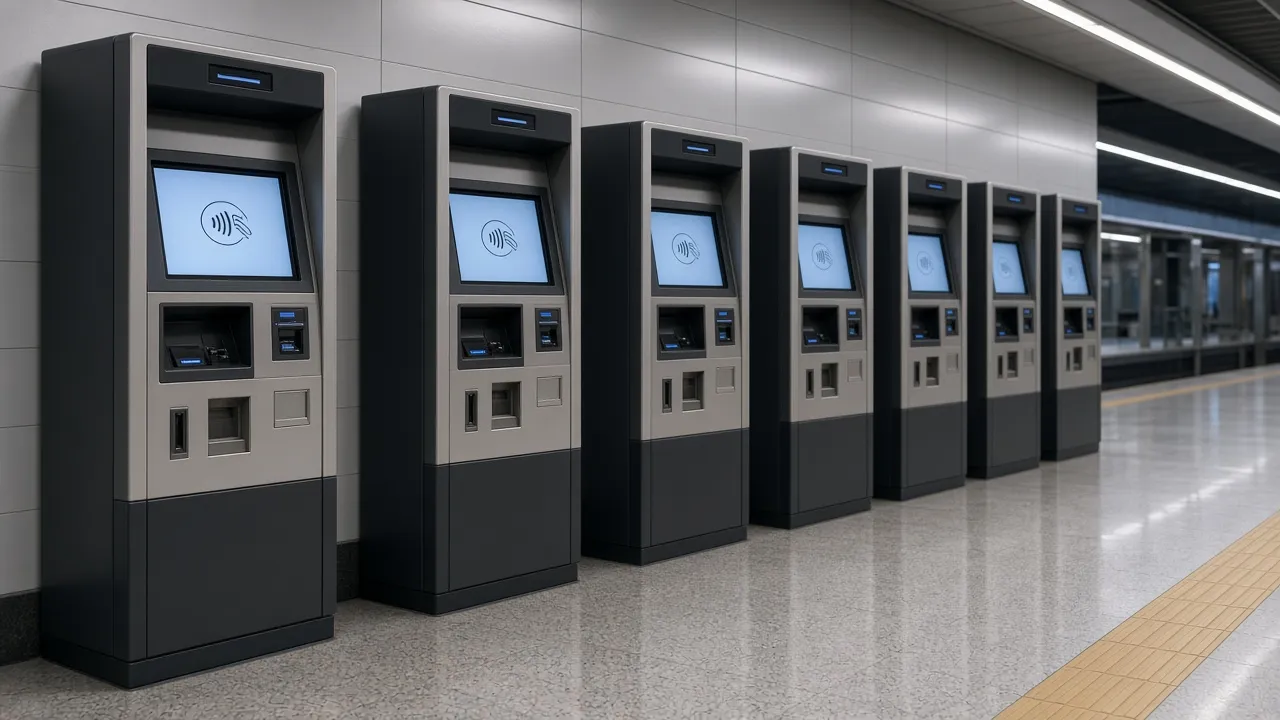
Ticket vending machines: what TVM means in 2026
Queries like «ticket vending machine», «TVM» or «train ticket machine» usually mean self-service fare sales for public transport — not snack vending. Riders pick origin/destination or a product, pay, and receive a travel title on thermal paper, smartcard load or on-screen QR.
The same self-service pattern appears for cinema, events, parking and museums with different software. This guide focuses mobility — where Europe is spending heavily in 2025–2026 — and how Project Vending drink/snack columns complement station atriums.
In Italy and across the EU, rail and urban operators pair apps and contactless with legacy TVMs, renewing estates for accessibility, cashless and shorter ticket-office queues.
Passenger journey: UI to valid ticket
Selection: touch or physical keys — language, zone fare, pass renewal, integrated rail+metro products where sold.
Payment: coins and notes (expensive to service), cards, contactless, wallets; some networks go digital-only to cut OPEX (e.g. Basel 2026–2027).
Fulfilment: thermal print with barcode/QR, load onto travel smartcard, or digital ticket to email when integrated.
Validation: tap at gate or show QR to staff — TVMs must stay synced with fares and deny lists in near real time.
Target under 60 seconds for experienced users; tourist-friendly UI matters at airports and interchanges.
- Central fare engine
- Print or card load
- QR and barcode
- Multi-language UI
- Receipts where required
Hardware: printer, cash recycler, display
Rail TVMs are rugged cabinets: 19–32" displays, chip readers, PIN pads, coin recyclers, note vaults, fast thermal printers.
Bus/tram compact units on stops: often contactless and QR only — lower unit cost (around half of full cash machines in Swiss rollouts).
Consumables: paper rolls, ribbons, note-path cleaning; telemetry warns before Sunday morning empty rolls.
Power: UPS to finish transactions during brief outages.
Europe 2025–2026: renewal wave
Germany (Mainz/Wiesbaden): 107 new TVMs, 32" screens, cashless plus cash, strengthened accessibility law.
France (Nouvelle-Aquitaine): ~190 TVMs across 174 TER stations in 2026 after Bordeaux/Limoges pilots.
Switzerland (Basel TNW): 363 cashless bus/tram TVMs by 2027, prepaid path for cash users.
UK: Southeastern 200+ TVMs in a £9M programme; Transport for Wales conversion/upgrade tender 2025–26.
Common thread: less cash, more barcode/app fulfilment, accessible UI (height, contrast, voice).
| Trend | Upside | Trade-off |
|---|---|---|
| Cashless only | ~60% lower cash OPEX | Unbanked travellers |
| Large touch | Tourist UX | Display damage risk |
| Hosted fares | Fast tariff updates | Network dependency |
| Paper barcode | Gate compatibility | Paper use |
| App integration | Shorter TVM queues | TVM as fallback |
Italy: urban transit, rail and accessibility
Major cities mix staffed desks, TVMs and apps; renewals often target unattended stops and secondary stations. Integrated zonal fares must match every channel.
Accessibility rules: control height, audio, tactile keys, contrast — new interchanges cluster TVMs on reachable routes.
Cash remains relevant for visitors and older riders; removing it needs prepaid alternatives and clear comms.
Maintenance: multi-year OEM contracts (Almex, Scheidt & Bachmann, Kuba, integrators) — not a one-off snack spiral purchase.
Beyond transit: cinema, events, parking
Cinema: seat picks or QR print; fewer box-office staff on peak nights.
Events/stadiums: web order pickup, badge printing — burst throughput.
Parking: entry tickets, extensions, pay-on-exit — linked barriers and ANPR.
Different software and certs from TPL; similar hardware stack. Project Vending supplies food vendors beside these lanes, not core TVMs.
Security, fraud and data
Cash attracts theft: armoured cassettes, scheduled empties, CCTV. Digital cuts theft but needs PCI discipline.
Ticket fraud: signed barcodes, gate sync, transaction audits.
GDPR: avoid unnecessary identity capture; optional email receipts.
Cyber: TVMs are endpoints — firmware patches, network segmentation, monitoring like retail POS.
Economics for authorities and operators
Rail TVM CAPEX: tens of thousands per unit with cash; less without recyclers. Deals bundle hosted fare software for 5–10 years.
Authority ROI: lower night staffing cost, more sales points in suburbs, data for service planning.
Riders expect parity with staffed channels; TVM surcharges are rare.
Project Vending snack/drink columns monetise waiting time — see our train-station sector article.
What Project Vending does in station hubs
We build Made-in-Italy vending machines (Maxima, Eurosnacky) for coffee, snacks and water — complementary to TVMs.
Projects cover atrium layout, power, branding, contactless and sales telemetry — not fare integration.
TVM tenders go to transport specialists; we align physical placement with passenger flow.
Subject «Ticket vending» vs «Station snack vending» clarifies routing.
Next steps
Transport bodies: OEM TVM specs with accessibility and cash strategy. Food operators: send dimensions, flow and product mix for Project Vending.
Contact our Veneto factory for complementary machines; follow authority tenders for TVM procurement.
FAQ
Does a TVM sell coffee?
No — travel products; coffee is a separate vendor.
Does Project Vending make TVMs?
No — we make snack and drink machines.
Can I travel with only an app?
Often yes; TVMs remain backup.
What does a TVM cost?
Roughly €15k compact to €40k+ with cash and hosting.
Is a cinema kiosk the same as rail?
Same self-service idea, different software stack.
Ready to get started?
Request a free consultation: we'll call you back within one business day with datasheets, a quote and location advice.